
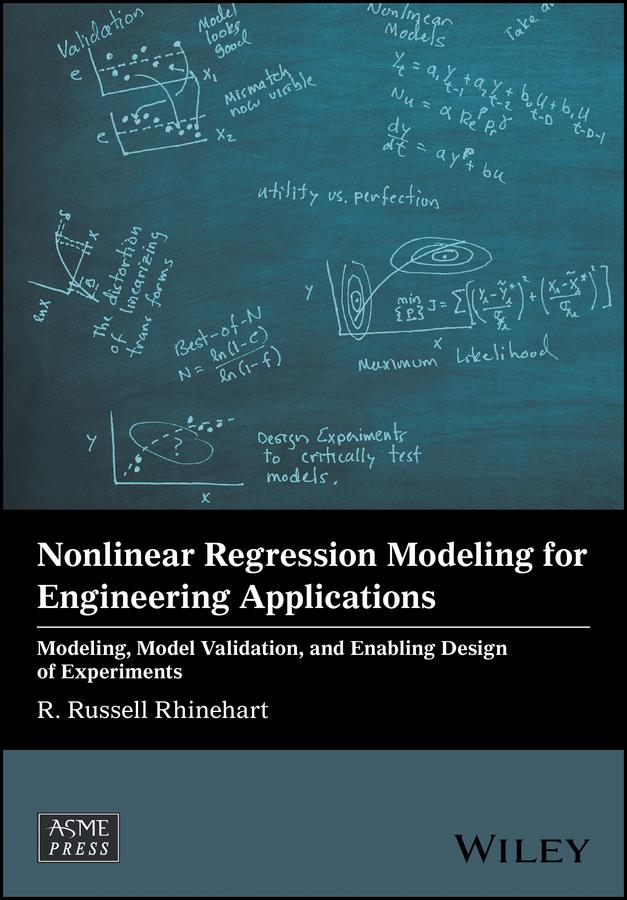
Since mathematical models express our understanding of how nature behaves, we use them to validate our understanding of the fundamentals about systems (which could be processes, equipment, procedures, devices, or products). Also, when validated, the model is useful for engineering applications related to diagnosis, design, and optimization.
First, we postulate a mechanism, then derive a model grounded in that mechanistic understanding. If the model does not fit the data, our understanding of the mechanism was wrong or incomplete. Patterns in the residuals can guide model improvement. Alternately, when the model fits the data, our understanding is sufficient and confidently functional for engineering applications.
This book details methods of nonlinear regression, computational algorithms,model validation, interpretation of residuals, and useful experimental design. The focus is on practical applications, with relevant methods supported by fundamental analysis.
This book will assist either the academic or industrial practitioner to properly classify the system, choose between the various available modeling options and regression objectives, design experiments to obtain data capturing critical system behaviors, fit the model parameters based on that data, and statistically characterize the resulting model. The author has used the material in the undergraduate unit operations lab course and in advanced control applications.
Zahle einfach mit Karte, Klarna, Apple Pay oder Google Pay. Nicht zufrieden? Du hast immer ein 14-tägiges Widerrufsrecht. Lies mehr in unseren AGB. Hast du Fragen, schreib uns eine E-Mail an hello@memmo.org.
Memmo macht das Lernen einfacher – wo auch immer du bist. Bei uns findest du deine Kursbücher und smarte Lerntools an einem Ort: Zusammenfassungen, Quizzes, Podcasts und Lernkarten. Und Ted, dein Lernbuddy, beantwortet alles, was du wissen möchtest. Über 50.000 Studierende lernen bereits hier – gemacht, damit du schneller lernst und weniger Stress hast.