
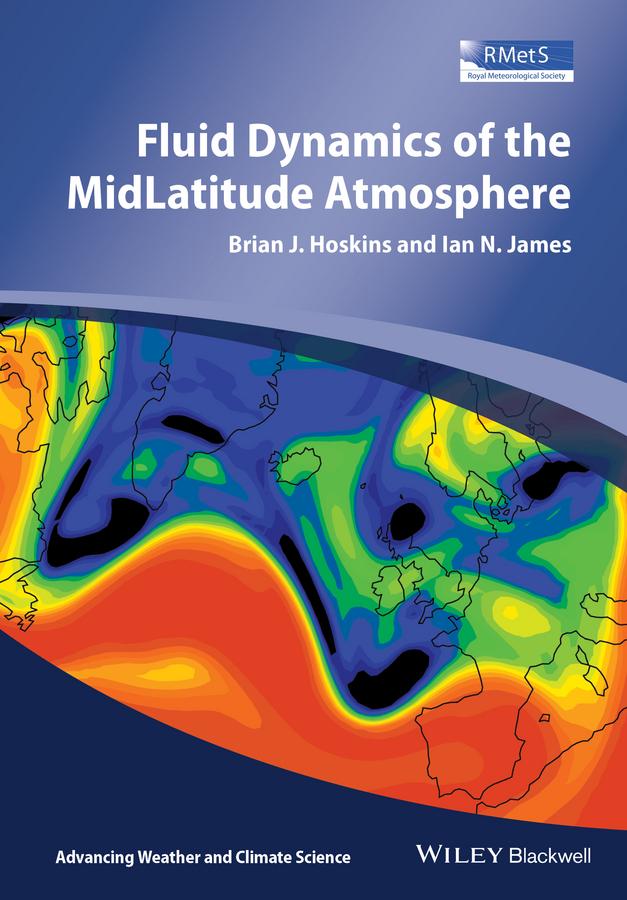
This book gives a coherent development of the current understanding of the fluid dynamics of the middle latitude atmosphere. It is primarily aimed at post-graduate and advanced undergraduate level students and does not assume any previous knowledge of fluid mechanics, meteorology or atmospheric science. The book will be an invaluable resource for any quantitative atmospheric scientist who wishes to increase their understanding of the subject. The importance of the rotation of the Earth and the stable stratification of its atmosphere, with their implications for the balance of larger-scale flows, is highlighted throughout.
Clearly structured throughout, the first of three themes deals with the development of the basic equations for an atmosphere on a rotating, spherical planet and discusses scale analyses of these equations. The second theme explores the importance of rotation and introduces vorticity and potential vorticity, as well as turbulence. In the third theme, the concepts developed in the first two themes are used to give an understanding of balanced motion in real atmospheric phenomena. It starts with quasi-geostrophic theory and moves on to linear and nonlinear theories for mid-latitude weather systems and their fronts. The potential vorticity perspective on weather systems is highlighted with a discussion of the Rossby wave propagation and potential vorticity mixing covered in the final chapter.
Clearly structured throughout, the first of three themes deals with the development of the basic equations for an atmosphere on a rotating, spherical planet and discusses scale analyses of these equations. The second theme explores the importance of rotation and introduces vorticity and potential vorticity, as well as turbulence. In the third theme, the concepts developed in the first two themes are used to give an understanding of balanced motion in real atmospheric phenomena. It starts with quasi-geostrophic theory and moves on to linear and nonlinear theories for mid-latitude weather systems and their fronts. The potential vorticity perspective on weather systems is highlighted with a discussion of the Rossby wave propagation and potential vorticity mixing covered in the final chapter.
Zahle einfach mit Karte, Klarna, Apple Pay oder Google Pay. Nicht zufrieden? Du hast immer ein 14-tägiges Widerrufsrecht. Lies mehr in unseren AGB. Hast du Fragen, schreib uns eine E-Mail an hello@memmo.org.
Memmo macht das Lernen einfacher – wo auch immer du bist. Bei uns findest du deine Kursbücher und smarte Lerntools an einem Ort: Zusammenfassungen, Quizzes, Podcasts und Lernkarten. Und Ted, dein Lernbuddy, beantwortet alles, was du wissen möchtest. Über 50.000 Studierende lernen bereits hier – gemacht, damit du schneller lernst und weniger Stress hast.