
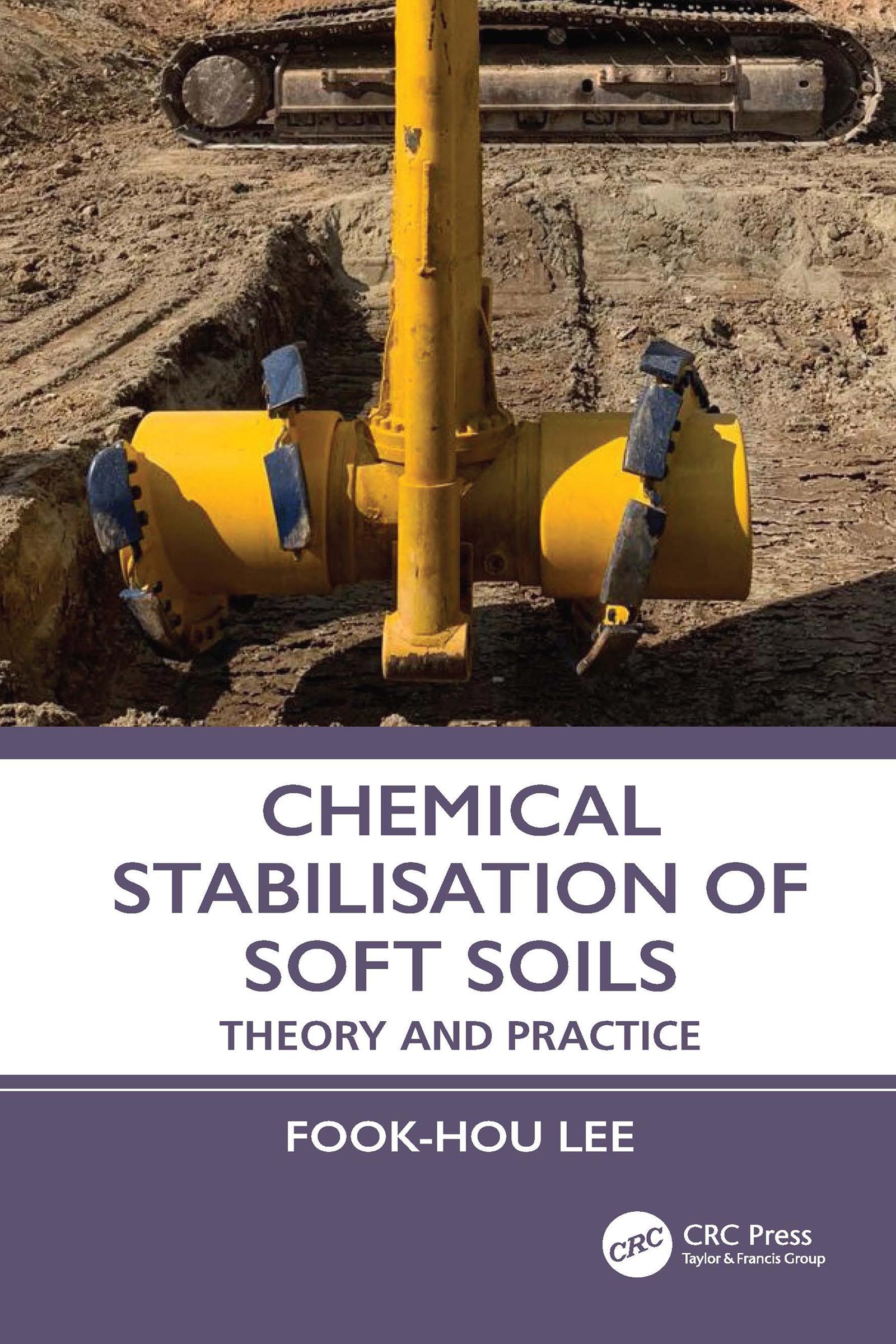
Chemical treatment is often used in ground engineering for the rapid stabilization of soft soil. Although different chemicals can be used, there are significant commonalities in their underlying principles and reactions. This book provides a holistic perspective on chemical stabilisation, covering its history, chemistry, factors affecting quality in the mixing processes, the properties and constitutive behaviour of improved soils, quality control, and design and construction.
Uniquely, this book draws out the interrelationships between the various methods of chemical stabilisation of soils. A key example is the relation between the water content and strength, constitutive behaviour, and uniformity of mixing. Operating parameters may produce conflicting results. For instance, a high water content promotes flowability and thus miscibility, but can also result in binder-soil segregation due to density differences. Furthermore, higher water content tends to degrade the strength of the treated soil. Hence, it is important to find an optimum balance.
This book is essential particularly for geotechnical engineers who are involved in the design and execution of chemical improvement of soil, as well as researchers.
Zahle einfach mit Karte, Klarna, Apple Pay oder Google Pay. Nicht zufrieden? Du hast immer ein 14-tägiges Widerrufsrecht. Lies mehr in unseren AGB. Hast du Fragen, schreib uns eine E-Mail an hello@memmo.org.
Memmo macht das Lernen einfacher – wo auch immer du bist. Bei uns findest du deine Kursbücher und smarte Lerntools an einem Ort: Zusammenfassungen, Quizzes, Podcasts und Lernkarten. Und Ted, dein Lernbuddy, beantwortet alles, was du wissen möchtest. Über 50.000 Studierende lernen bereits hier – gemacht, damit du schneller lernst und weniger Stress hast.