
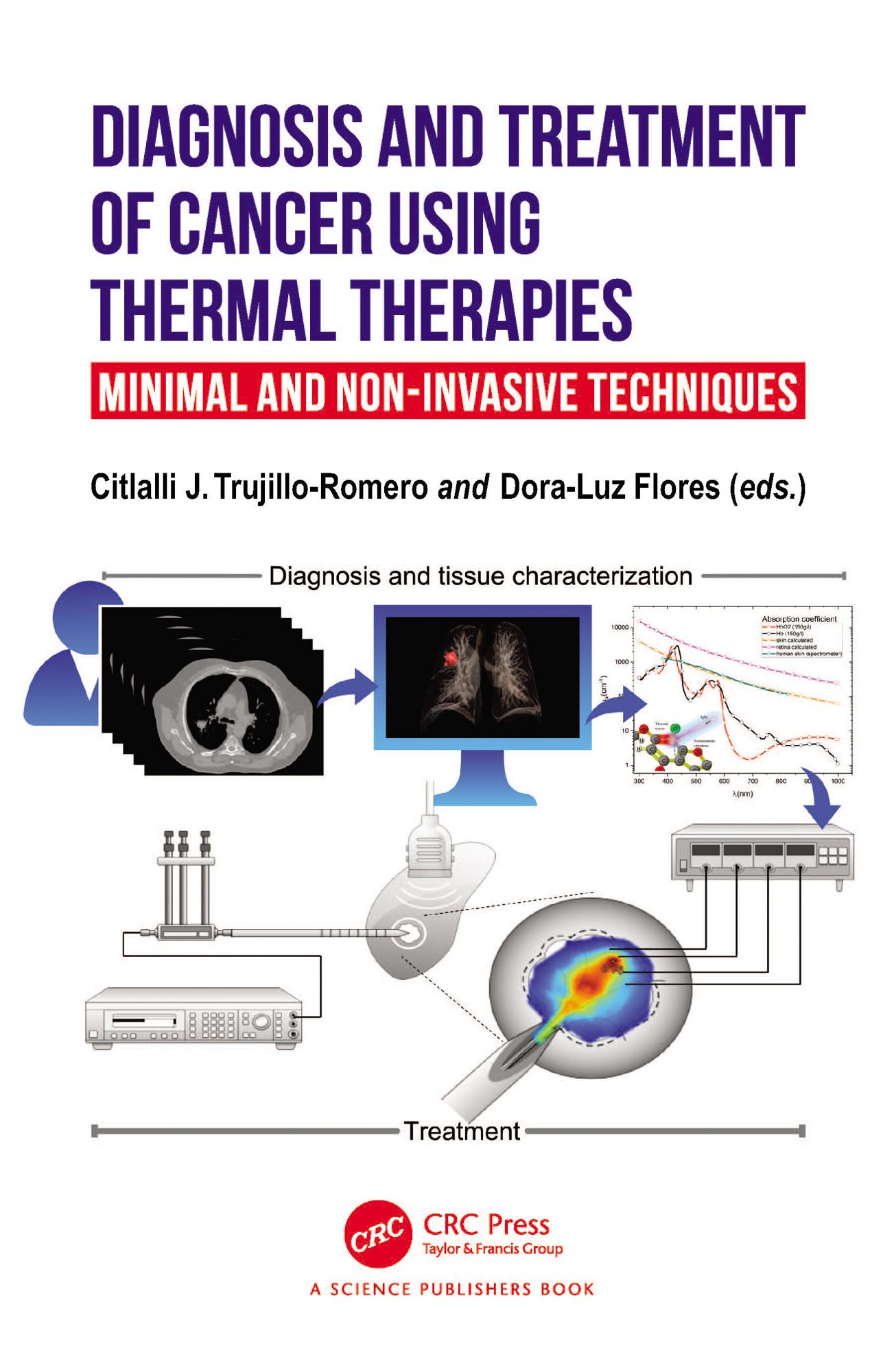
New research is being conducted in the diagnosis and new treatments of cancer that has high efficacy and are minimally invasiveness. Artificial intelligence, bioimpedance, thermal images and nanomaterials have been used to provide early diagnosis. New treatments based on the generation of microwaves, radiofrequency, or ultrasound have been proposed in the last couple of decades. Although thermotherapies have been shown to be efficient, for them to be considered as a primary treatment, they must overcome some hurdles. One of the main challenges is to ensure applicators that point the electromagnetic or the mechanical waves at a tumor, don't affect the surrounding healthy tissues. In some cases, nanoparticles have also been designed to achieve better focus. The design of new applicators can be made by computational models based on methods such as the finite element. However, to efficiently predict the applicator’s performance, it is important that dielectric, thermal, and acoustic properties (tissue characterization) are included in the models. Not only healthy tissue, but also tumors must be characterized. Patient specific treatment planning, which consists of a 3D patient model based on medical images, can be developed to implement a safety treatment. Moreover, tissue properties as well as the applicator must be defined. Parameters such as temperature increase, and heat pattern must be evaluated to ensure patient safety and treatment success.
Zahle einfach mit Karte, Klarna, Apple Pay oder Google Pay. Nicht zufrieden? Du hast immer ein 14-tägiges Widerrufsrecht. Lies mehr in unseren AGB. Hast du Fragen, schreib uns eine E-Mail an hello@memmo.org.
Memmo macht das Lernen einfacher – wo auch immer du bist. Bei uns findest du deine Kursbücher und smarte Lerntools an einem Ort: Zusammenfassungen, Quizzes, Podcasts und Lernkarten. Und Ted, dein Lernbuddy, beantwortet alles, was du wissen möchtest. Über 50.000 Studierende lernen bereits hier – gemacht, damit du schneller lernst und weniger Stress hast.