
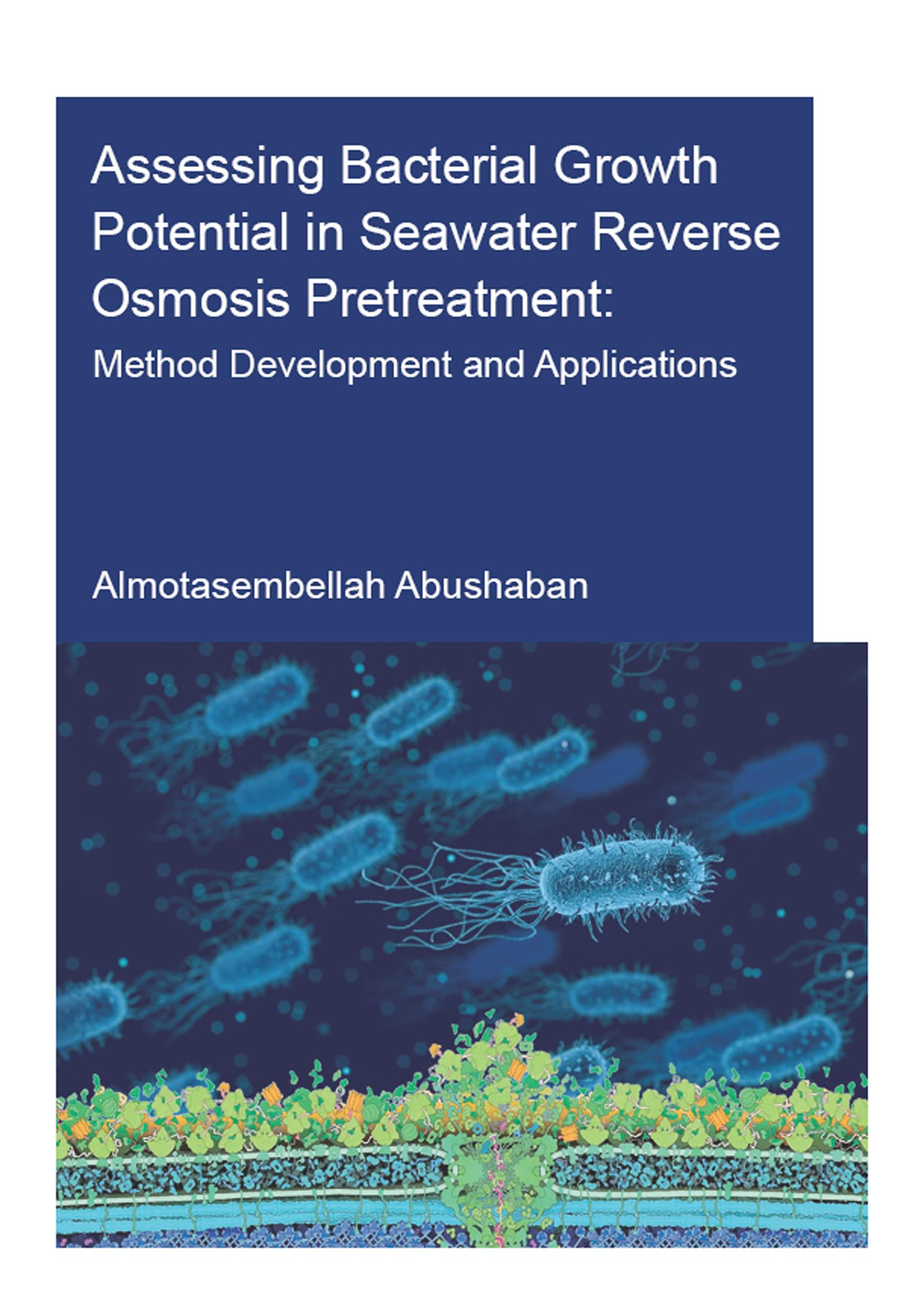
Seawater desalination is increasingly being used as a means to augment freshwater supplies in regions with high water stress, and reverse osmosis is increasingly the technology of choice because of the low energy consumption. However, seawater reverse osmosis (SWRO) systems suffer from various types of fouling, which can increase energy consumption and the use of chemicals during SWRO operation. In practice, pre-treatment systems are put in place to reduce the particulate and biological fouling potential of SWRO feed water. However, simple, reliable and accurate methods to assess the extent to which biological fouling potential is reduced during pre-treatment are not available for seawater.
This research developed a new method to measure bacterial growth potential (BGP) using the native bacterial consortium in seawater. New reagents to extract and detect ATP in microbial cells were specifically developed for seawater. The new lysis and detection reagents overcame the salt interference in seawater and allow low detection of total ATP, free ATP and microbial ATP in seawater. Incorporating a filtration step further increased the sensitivity of the method six fold, enabling ATP detection of ultra-low levels of microbial ATP in seawater.
The newly developed ATP-based BGP method was applied to monitor and assess the pre-treatment of five full-scale seawater desalination plants around the world. A good correlation was observed between BGP measured in SWRO feed water and the pressure drop increase in the SWRO systems, suggesting the applicability of using the ATP-based BGP method as a biofouling indicator in SWRO. Furthermore, a safe level of BGP (<70 µg/L) is proposed for SWRO feed water in order to ensure a chemical cleaning frequency of once/year or lower. However, to validate this conclusion, more SWRO plants with different pre-treatment systems need to be monitored.
In the future, on-line monitoring of BGP in SWRO feed water may further reduce the consumption of chemicals and energy and improve the overall sustainability of seawater desalination by reverse osmosis.
Zahle einfach mit Karte, Klarna, Apple Pay oder Google Pay. Nicht zufrieden? Du hast immer ein 14-tägiges Widerrufsrecht. Lies mehr in unseren AGB. Hast du Fragen, schreib uns eine E-Mail an hello@memmo.org.
Memmo macht das Lernen einfacher – wo auch immer du bist. Bei uns findest du deine Kursbücher und smarte Lerntools an einem Ort: Zusammenfassungen, Quizzes, Podcasts und Lernkarten. Und Ted, dein Lernbuddy, beantwortet alles, was du wissen möchtest. Über 50.000 Studierende lernen bereits hier – gemacht, damit du schneller lernst und weniger Stress hast.