
Innan Memmo hade jag PDF:er överallt. Nu samlar en workspace allt — och jag ser exakt vad som är kvar att plugga på.
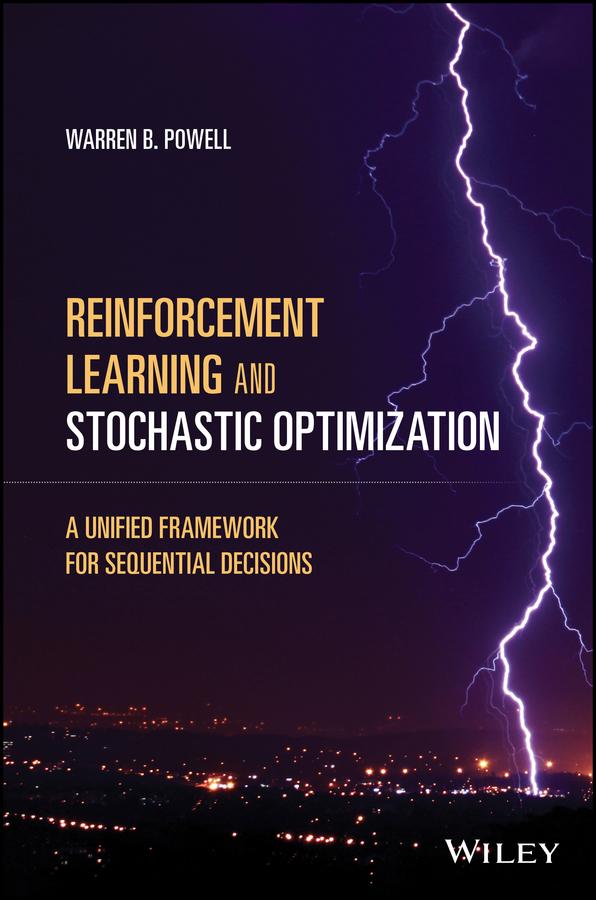
REINFORCEMENT LEARNING AND STOCHASTIC OPTIMIZATION
Clearing the jungle of stochastic optimization
Sequential decision problems, which consist of “decision, information, decision, information,” are ubiquitous, spanning virtually every human activity ranging from business applications, health (personal and public health, and medical decision making), energy, the sciences, all fields of engineering, finance, and e-commerce. The diversity of applications attracted the attention of at least 15 distinct fields of research, using eight distinct notational systems which produced a vast array of analytical tools. A byproduct is that powerful tools developed in one community may be unknown to other communities.
Reinforcement Learning and Stochastic Optimization offers a single canonical framework that can model any sequential decision problem using five core components: state variables, decision variables, exogenous information variables, transition function, and objective function. This book highlights twelve types of uncertainty that might enter any model and pulls together the diverse set of methods for making decisions, known as policies, into four fundamental classes that span every method suggested in the academic literature or used in practice.
Reinforcement Learning and Stochastic Optimization is the first book to provide a balanced treatment of the different methods for modeling and solving sequential decision problems, following the style used by most books on machine learning, optimization, and simulation. The presentation is designed for readers with a course in probability and statistics, and an interest in modeling and applications. Linear programming is occasionally used for specific problem classes. The book is designed for readers who are new to the field, as well as those with some background in optimization under uncertainty.
Throughout this book, readers will find references to over 100 different applications, spanning pure learning problems, dynamic resource allocation problems, general state-dependent problems, and hybrid learning/resource allocation problems such as those that arose in the COVID pandemic. There are 370 exercises, organized into seven groups, ranging from review questions, modeling, computation, problem solving, theory, programming exercises and a "diary problem" that a reader chooses at the beginning of the book, and which is used as a basis for questions throughout the rest of the book.
Innan Memmo hade jag PDF:er överallt. Nu samlar en workspace allt — och jag ser exakt vad som är kvar att plugga på.
Memmos sammanfattningar är guld inför tentan. Jag slipper läsa 800 sidor två veckor innan — bara det viktigaste.
AI-chatten har räddat mig kvällen innan tentan mer än en gång. Jag frågar tills jag fattar — och slipper vänta på svar i någon studiegrupp.
Quizen är på precis det jag behöver kunna. Memmo håller koll på vad jag fastnar på — så jag övar bara på det som är värt det.
Flashcardsen med spaced repetition är magi. Memmo vet när jag är på väg att glömma något och visar det igen.
AI-poddarna är min favorit. Jag lyssnar på vägen till skolan och får repetition utan att sätta mig framför datorn.

Handbok i kvalitativa metoder
281 kr

Hållbar utveckling: en introduktion för ingenjörer och andra problemlösare
334 kr

Brymans Samhällsvetenskapliga metoder
390 kr

Projektledning
491 kr

Den orättvisa hälsan: om socioekonomiska skillnader i hälsa och livslängd
326 kr

Vetenskapsteori för nybörjare
196 kr

Organizational Leadership
429 kr

På väg mot läraryrket
172 kr

Det sociala livet i skolan: Socialpsykologiska perspektiv
253 kr

Betygsättningens didaktik
151 kr

Personality
402 kr

Studying Leadership
404 kr

Managing Innovation
449 kr

Introduktion till samhällsvetenskaplig metod
347 kr

The Psychology of Sex and Gender
698 kr

Evidens och kunskap för socialt arbete
207 kr

Introduction to Leadership
605 kr