
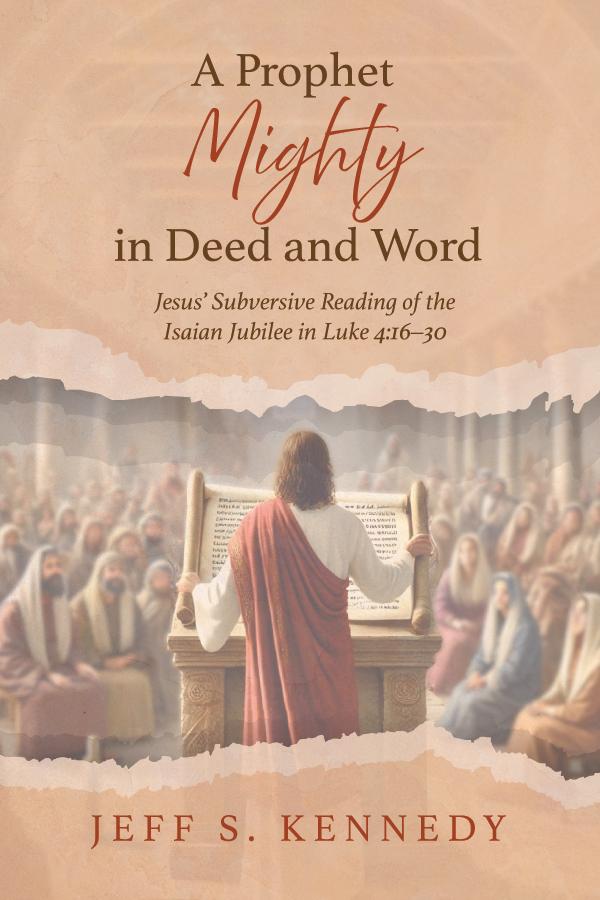
Did Jesus, the revolutionary figure who changed the world, struggle to read a scroll? A growing number of scholars think so. Luke's account of Jesus reading in the synagogue (Luke 4:16-30) is routinely challenged today in academia. The claim is that Luke either fabricated the account outright or relied upon a mistaken social memory of Jesus reading in the synagogue. Accordingly, Jesus has been recast as an illiterate peasant or semi-literate artisan unable to read and teach the way Luke portrays.
In A Prophet Mighty in Deed and Word, Jeff Kennedy offers a fresh perspective. He contends that Luke's "reading Jesus" wasn't an attempt to appeal to the cultured sensibilities of his Greek audience, who preferred literate philosophers over illiterate carpenters. Instead, it reflects Jesus' self-understanding as Israel's prophet-sage, anointed to read and proclaim the year of Yahweh's favor.
Jesus announces a shocking and provocative message for unbelieving Israel, and he does so with a singular authority. This incident sparks escalating tensions between Jesus and his countrymen, resulting in Christ's glorification through suffering. And Luke tells us that suffering began in Jesus' hometown of Nazareth.
Płać wygodnie kartą, Klarną, Apple Pay lub Google Pay. Nie jesteś zadowolony? Zawsze masz 14-dniową gwarancję zwrotu pieniędzy. Więcej przeczytasz w naszych warunkach. Masz pytania? Napisz do nas na hello@memmo.org.
Memmo ułatwia naukę – gdziekolwiek jesteś na świecie. U nas znajdziesz podręczniki i sprytne narzędzia do nauki w jednym miejscu: streszczenia, quizy, podcasty i fiszki. A do tego Ted, Twój kumpel do nauki, który odpowie na wszystko, co Cię nurtuje. Ponad 50 000 studentów już tu się uczy – stworzone, byś uczył się szybciej i mniej stresował.
Może Ci się spodobać
Kup książkę0