
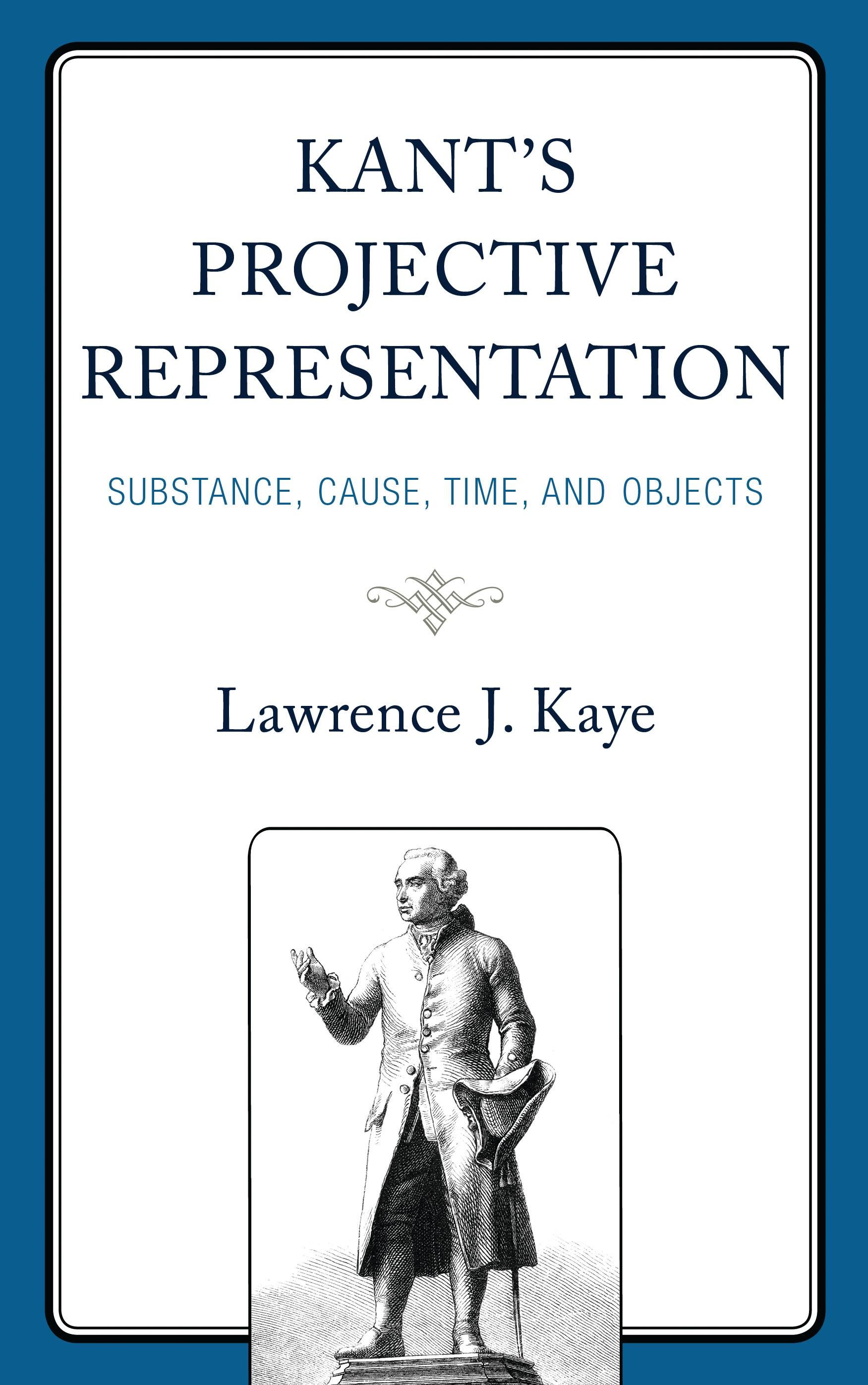
Kant’s Projective Representation: Substance, Cause, Time, and Objects is a textually thorough study of Kant’s account of mental representation that yields a new understanding of the primary doctrines of the Critique of Pure Reason. Lawrence J. Kaye argues that in the Transcendental Deduction, the analytic unity of concepts establishes the necessary unity of consciousness, which also constitutes representation. In the First Analogy, Kant argues that our ability to represent sequences, simultaneity, and durations rests on the conceptually prior representation of persistence. Without persistence in empirical perceptions, we must represent persistence with identities across intuitions that project an external world of persistent matter. The other Analogies explain how we represent sequences through necessitated state transitions in objects and how we represent simultaneity through mutual influence. These pure unifications that constitute representation are the schematized (relational) categories—instances of the same types of unifying functions that underlie the concepts of substance, causation, and community. We know a priori that all perceptual experiences will project a world with this structure, which is synthetic a priori metaphysical knowledge. This interpretation also shows how Kant reconciles realism and idealism: we empirically represent a world that is external to consciousness, but we do so by using unities that are purely mental constructions.
Płać wygodnie kartą, Klarną, Apple Pay lub Google Pay. Nie jesteś zadowolony? Zawsze masz 14-dniową gwarancję zwrotu pieniędzy. Więcej przeczytasz w naszych warunkach. Masz pytania? Napisz do nas na hello@memmo.org.
Memmo ułatwia naukę – gdziekolwiek jesteś na świecie. U nas znajdziesz podręczniki i sprytne narzędzia do nauki w jednym miejscu: streszczenia, quizy, podcasty i fiszki. A do tego Ted, Twój kumpel do nauki, który odpowie na wszystko, co Cię nurtuje. Ponad 50 000 studentów już tu się uczy – stworzone, byś uczył się szybciej i mniej stresował.