
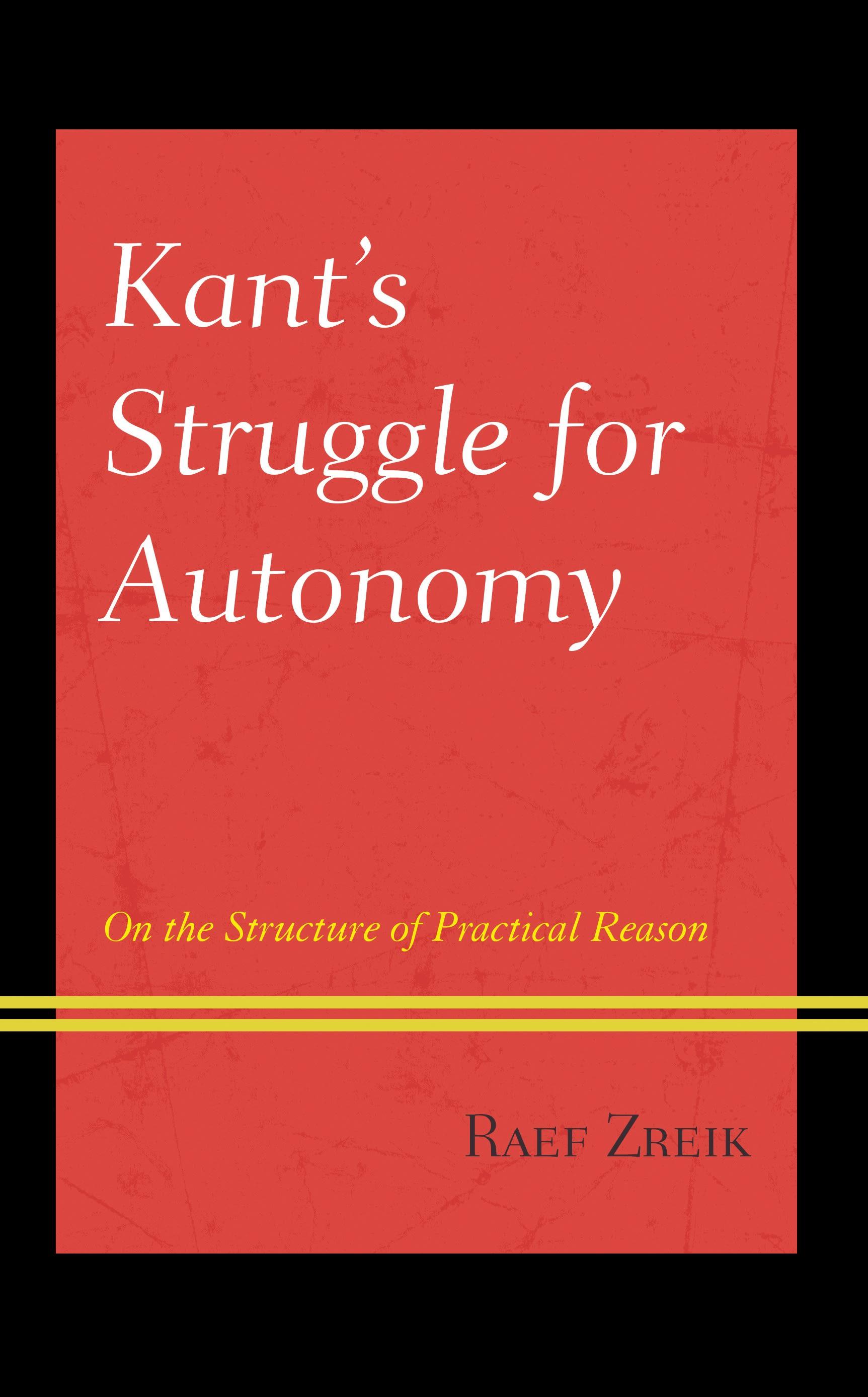
In Kant’s Struggle for Autonomy: On the Structure of Practical Reason, Raef Zreik presents an original synoptic view of Kant’s practical philosophy, uncovering the relatively hidden architectonics of Kant’s system and critically engaging with its broad implications. He begins by investigating the implicit strategy that guides Kant in making the distinctions that establish the autonomous spheres: happiness, morality, justice, public order-legitimacy. The organizing principle of autonomy sets these spheres apart, assuming there is self-sufficiency for each sphere. Zreik then develops a critique of this strategy, showing its limits, its costs, and its inherent instability. He questions self-sufficiency and argues that autonomy is a matter of ongoing struggle between the forces of separation and unification. Zreik proceeds to suggest that we “read Kant backward,” reading early Kant in light of late Kant. This reading reveals Kant's strategy of both taking things apart and putting them together, focusing on the joints, transitions, and metastructures of the system. The image emanating from this account of Kant’s legal and moral philosophy is of an intimate yet tragic conflict within Kant’s thought—one that leaves us to our own judgment as to where to draw the boundaries between spheres, opening the door for politicizing Kant's practical philosophy.
Płać wygodnie kartą, Klarną, Apple Pay lub Google Pay. Nie jesteś zadowolony? Zawsze masz 14-dniową gwarancję zwrotu pieniędzy. Więcej przeczytasz w naszych warunkach. Masz pytania? Napisz do nas na hello@memmo.org.
Memmo ułatwia naukę – gdziekolwiek jesteś na świecie. U nas znajdziesz podręczniki i sprytne narzędzia do nauki w jednym miejscu: streszczenia, quizy, podcasty i fiszki. A do tego Ted, Twój kumpel do nauki, który odpowie na wszystko, co Cię nurtuje. Ponad 50 000 studentów już tu się uczy – stworzone, byś uczył się szybciej i mniej stresował.