
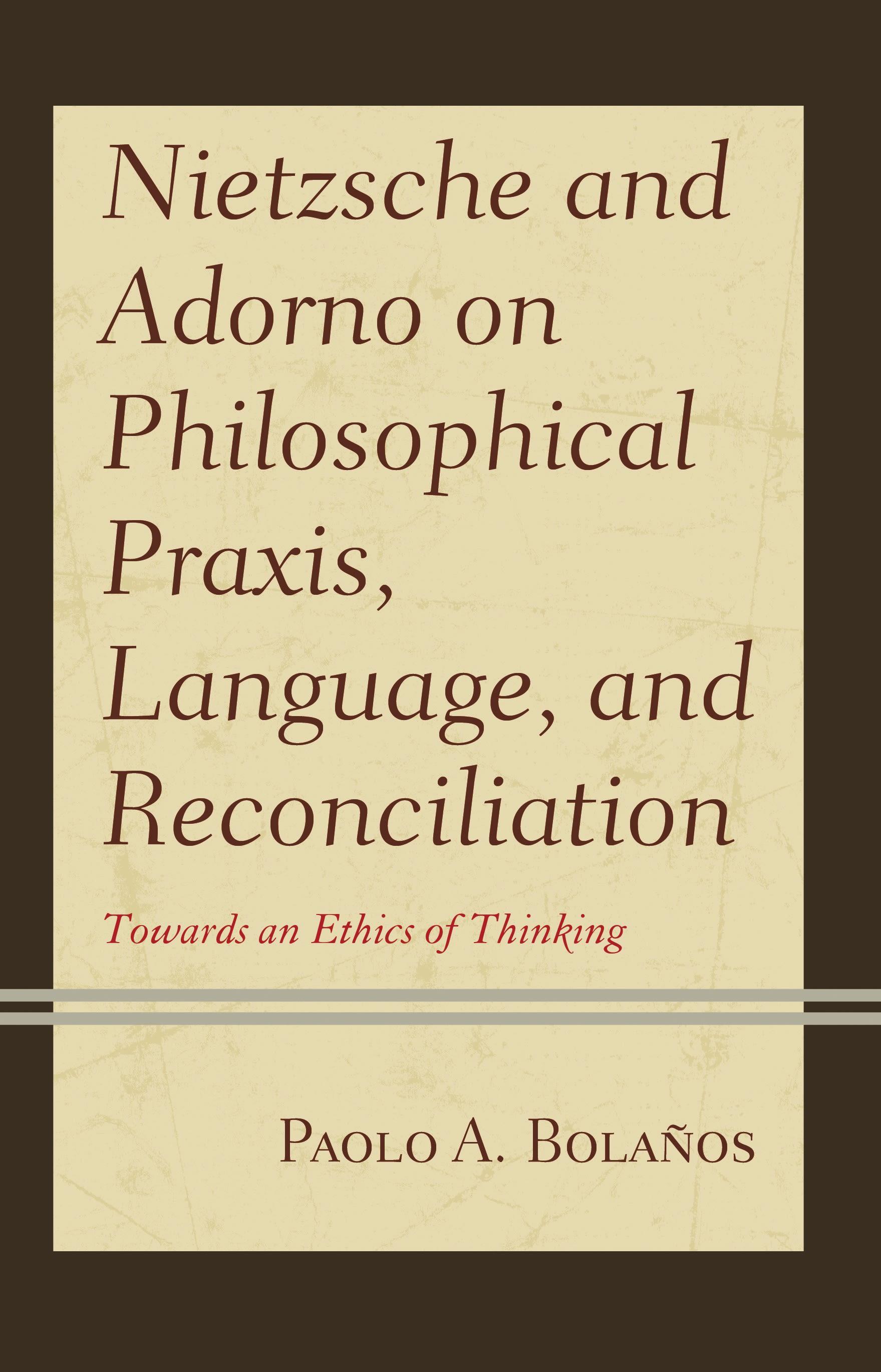
Nietzsche and Adorno on Philosophical Praxis, Language, and Reconciliation: Towards an Ethics of Thinking offers a philosophical notion of an “ethics of thinking,” a kind of thinking that is receptive to the non-identical character of the world of human and non-human objects. Paolo A. Bolaños experiments with the ideas of Friedrich Nietzsche and Theodor W. Adorno, who are presented as contemporary proponents of the Frühromantik tradition. Bolaños offers a reconstruction of the respective philosophies of language of Nietzsche and Adorno, as well as a rehearsal of their critique of metaphysics and identity thinking, in order to develop a notion of philosophical praxis that is grounded in the ethical dimension of thinking. Via Nietzsche and Adorno, Bolaños argues that thinking’s performative participation in uncertainty broadens the domain of reason, thereby also broadening our conceptual capacities and our receptivity to new possibilities of thinking. As an ethical praxis, thinking guards itself from the error of solidification, thereby opening philosophy to a reconciliatory, as opposed to domineering, reception of the world.
Płać wygodnie kartą, Klarną, Apple Pay lub Google Pay. Nie jesteś zadowolony? Zawsze masz 14-dniową gwarancję zwrotu pieniędzy. Więcej przeczytasz w naszych warunkach. Masz pytania? Napisz do nas na hello@memmo.org.
Memmo ułatwia naukę – gdziekolwiek jesteś na świecie. U nas znajdziesz podręczniki i sprytne narzędzia do nauki w jednym miejscu: streszczenia, quizy, podcasty i fiszki. A do tego Ted, Twój kumpel do nauki, który odpowie na wszystko, co Cię nurtuje. Ponad 50 000 studentów już tu się uczy – stworzone, byś uczył się szybciej i mniej stresował.