
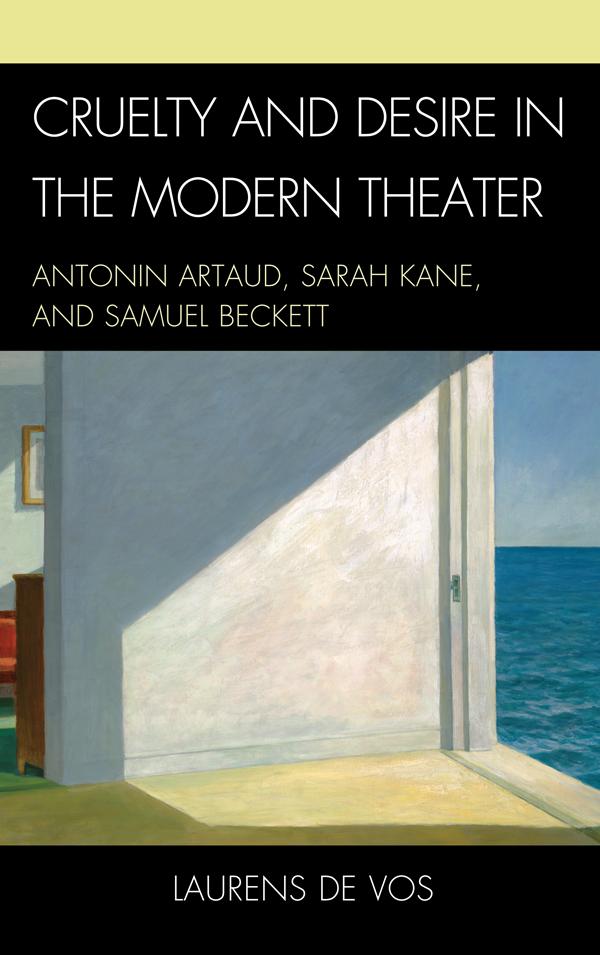
Departing from a refreshing look at the ideas of Antonin Artaud, this book provides a thorough analysis of how both Sarah Kane and Samuel Beckett are indebted to his legacy. In juxtaposing these playwrights, De Vos minutely points out how both in their own way struggle with coming to terms with Artaud. A key concept in Lacanian psychoanalytic theories, desire lies at the root of the Theatre of Cruelty; Kane and Beckett prove that desire and cruelty are inextricably linked to one another, but that they appear in radically different disguises. Relying on Kane and Beckett, this book not only sheds a light on the precise intentions behind Artaud's project, it also maps out the structural parallels and dichotomies between the Theatre of Cruelty and the literary genre of tragedy.
Immediately after the premiere of Sarah Kane's Blasted in 1995, some reviewers made a link with Antonin Artaud's Theatre of Cruelty. These parallels, however, were solely based on the abundance of physical violence on stage. In response to these assertions, this book traces minutely Artaud's legacy for later generations. Making use of Jacques Lacan's psychoanalytical ideas as a theoretical framework, De Vos defines Artaud's project not so much in terms of blood and goriness, but rather as a theater of Passion, revolving around notions as desire, love and the subjectile, a concept that was drawn attention to by Derrida. In addition, the idea of the scapegoat delineated by René Girard provides a leg-up to clarify the intrinsic parallels as well as divergences between the Theatre of Cruelty and tragedy, while also Lacan's analysis of Antigone is being looked at.
Phaedra's Love, Cleansed and 4.48 Psychosis are extensively dealt with in this study, and point out the development Kane went through in her short but at the same time long trajectory. The third part on Beckett focuses primarily on Krapp's Last Tape and Not I, and equally so calls in Lacan to understand self-alienation and self-conceptua
Immediately after the premiere of Sarah Kane's Blasted in 1995, some reviewers made a link with Antonin Artaud's Theatre of Cruelty. These parallels, however, were solely based on the abundance of physical violence on stage. In response to these assertions, this book traces minutely Artaud's legacy for later generations. Making use of Jacques Lacan's psychoanalytical ideas as a theoretical framework, De Vos defines Artaud's project not so much in terms of blood and goriness, but rather as a theater of Passion, revolving around notions as desire, love and the subjectile, a concept that was drawn attention to by Derrida. In addition, the idea of the scapegoat delineated by René Girard provides a leg-up to clarify the intrinsic parallels as well as divergences between the Theatre of Cruelty and tragedy, while also Lacan's analysis of Antigone is being looked at.
Phaedra's Love, Cleansed and 4.48 Psychosis are extensively dealt with in this study, and point out the development Kane went through in her short but at the same time long trajectory. The third part on Beckett focuses primarily on Krapp's Last Tape and Not I, and equally so calls in Lacan to understand self-alienation and self-conceptua
Strony: 256
Kategoria: Drama, Teater & Scenkonst
e-ISBN: 9781611470451
Waga przesyłki: 1.2 kg
Wysyłka w ciągu: 1-2 dni
Płać wygodnie kartą, Klarną, Apple Pay lub Google Pay. Nie jesteś zadowolony? Zawsze masz 14-dniową gwarancję zwrotu pieniędzy. Więcej przeczytasz w naszych warunkach. Masz pytania? Napisz do nas na hello@memmo.org.
Memmo ułatwia naukę – gdziekolwiek jesteś na świecie. U nas znajdziesz podręczniki i sprytne narzędzia do nauki w jednym miejscu: streszczenia, quizy, podcasty i fiszki. A do tego Ted, Twój kumpel do nauki, który odpowie na wszystko, co Cię nurtuje. Ponad 50 000 studentów już tu się uczy – stworzone, byś uczył się szybciej i mniej stresował.