
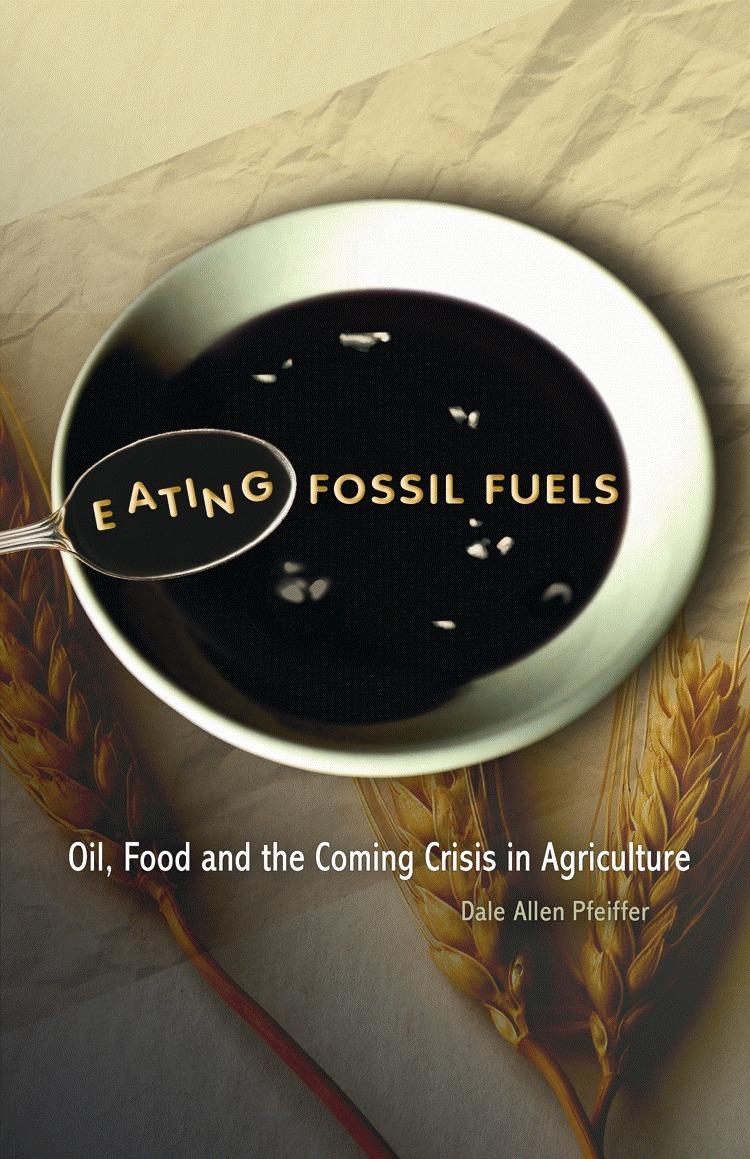
The miracle of the Green Revolution was made possible by cheap fossil fuels to supply crops with artificial fertilizer, pesticides, and irrigation. Estimates of the net energy balance of agriculture in the United States show that ten calories of hydrocarbon energy are required to produce one calorie of food. Such an imbalance cannot continue in a world of diminishing hydrocarbon resources.
Eating Fossil Fuels examines the interlinked crises of energy and agriculture and highlights some startling findings:
• The worldwide expansion of agriculture has appropriated fully 40 percent of the photosynthetic capability of this planet.
• The Green Revolution provided abundant food sources for many, resulting in a population explosion well in excess of the planet’s carrying capacity.
• Studies suggest that without fossil fuel-based agriculture, the United States could only sustain about two-thirds of its present population. For the planet as a whole, the sustainable number is estimated to be about two billion.
Concluding that the effect of energy depletion will be disastrous without a transition to a sustainable, re-localized agriculture, the book draws on the experiences of North Korea and Cuba to demonstrate stories of failure and success in the transition to non-hydrocarbon-based agriculture. It urges strong grassroots activism for sustainable, localized agriculture and a natural shrinking of the world’s population.
Eating Fossil Fuels examines the interlinked crises of energy and agriculture and highlights some startling findings:
• The worldwide expansion of agriculture has appropriated fully 40 percent of the photosynthetic capability of this planet.
• The Green Revolution provided abundant food sources for many, resulting in a population explosion well in excess of the planet’s carrying capacity.
• Studies suggest that without fossil fuel-based agriculture, the United States could only sustain about two-thirds of its present population. For the planet as a whole, the sustainable number is estimated to be about two billion.
Concluding that the effect of energy depletion will be disastrous without a transition to a sustainable, re-localized agriculture, the book draws on the experiences of North Korea and Cuba to demonstrate stories of failure and success in the transition to non-hydrocarbon-based agriculture. It urges strong grassroots activism for sustainable, localized agriculture and a natural shrinking of the world’s population.
Strony: 125
Kategoria: Miljövetenskap & Klimat
e-ISBN: 9781550923766
Waga przesyłki: 1.2 kg
Wysyłka w ciągu: 1-2 dni
Płać wygodnie kartą, Klarną, Apple Pay lub Google Pay. Nie jesteś zadowolony? Zawsze masz 14-dniową gwarancję zwrotu pieniędzy. Więcej przeczytasz w naszych warunkach. Masz pytania? Napisz do nas na hello@memmo.org.
Memmo ułatwia naukę – gdziekolwiek jesteś na świecie. U nas znajdziesz podręczniki i sprytne narzędzia do nauki w jednym miejscu: streszczenia, quizy, podcasty i fiszki. A do tego Ted, Twój kumpel do nauki, który odpowie na wszystko, co Cię nurtuje. Ponad 50 000 studentów już tu się uczy – stworzone, byś uczył się szybciej i mniej stresował.
Może Ci się spodobać
Kup książkę0