
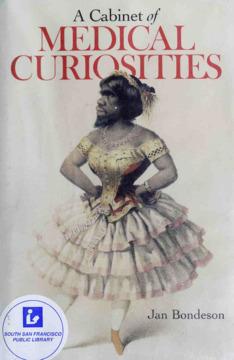
Long ago, curiosities were arranged in cabinets for display: a dried mermaid might be next to a giant's shinbone, the skeletons of conjoined twins beside an Egyptian mummy. In ten essays, Jan Bondeson brings a physician's diagnostic skills to various unexpected, gruesome, and extraordinary aspects of the history of medicine: spontaneous human combustion, colonies of snakes and frogs living in a person's stomach, kings and emperors devoured by lice, vicious tribes of tailed men, and the Two-Headed Boy of Bengal.
Bondeson tells the story of Mary Toft, who gained notoriety in 1726 when she allegedly gave birth to seventeen rabbits. King George I, the Prince of Wales, and the court physicians attributed these monstrous births to a "maternal impression" because Mary had longed for a meal of rabbit while pregnant. Bondeson explains that the fallacy of maternal impressions, conspicuous in the novels of Goethe, Sir Walter Scott, and Charles Dickens, has ancient roots in Chinese and Babylonian manuscripts.
Bondeson also presents the tragic case of Julia Pastrana, a Mexican Indian woman with thick hair growing over her body and a massive overgrowth of the gums that gave her a simian or ape-like appearance. Called the Ape Woman, she was exhibited all over the world. After her death in 1860, Julia's husband, who had also been her impresario, had her body mummified and continued to exhibit it throughout Europe. Bondeson tracked the mummy down and managed to diagnose Julia Pastrana's condition as the result of a rare genetic syndrome.
Płać wygodnie kartą, Klarną, Apple Pay lub Google Pay. Nie jesteś zadowolony? Zawsze masz 14-dniową gwarancję zwrotu pieniędzy. Więcej przeczytasz w naszych warunkach. Masz pytania? Napisz do nas na hello@memmo.org.
Memmo ułatwia naukę – gdziekolwiek jesteś na świecie. U nas znajdziesz podręczniki i sprytne narzędzia do nauki w jednym miejscu: streszczenia, quizy, podcasty i fiszki. A do tego Ted, Twój kumpel do nauki, który odpowie na wszystko, co Cię nurtuje. Ponad 50 000 studentów już tu się uczy – stworzone, byś uczył się szybciej i mniej stresował.