
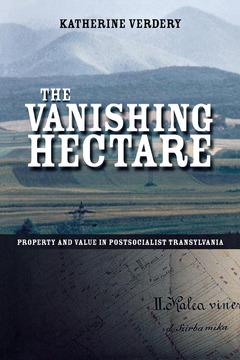
In most countries in Eastern Europe and the former Soviet Union, the fall of communism opened up the possibility for individuals to acquire land. Based on Katherine Verdery's extensive fieldwork between 1990 and 2001, The Vanishing Hectare explores the importance of land and land ownership to the people of one Transylvanian community, Aurel Vlaicu. Verdery traces how collectivized land was transformed into private property, how land was valued, what the new owners were able to do with it, and what it signified to each of the different groups vying for land rights.
Verdery tells this story about transforming socialist property forms in a global context, showing the fruitfulness of conceptualizing property as a political symbol, as a complex of social relations among people and things, and as a process of assigning value. This book is a window on rural life after socialism but it also provides a framework for assessing the neo-liberal economic policies that have prevailed elsewhere, such as in Latin America. Verdery shows how the trajectory of property after socialism was deeply conditioned by the forms property took in socialism itself; this is in contrast to the image of a "tabula rasa" that governed much thinking about post-socialist property reform.
Płać wygodnie kartą, Klarną, Apple Pay lub Google Pay. Nie jesteś zadowolony? Zawsze masz 14-dniową gwarancję zwrotu pieniędzy. Więcej przeczytasz w naszych warunkach. Masz pytania? Napisz do nas na hello@memmo.org.
Memmo ułatwia naukę – gdziekolwiek jesteś na świecie. U nas znajdziesz podręczniki i sprytne narzędzia do nauki w jednym miejscu: streszczenia, quizy, podcasty i fiszki. A do tego Ted, Twój kumpel do nauki, który odpowie na wszystko, co Cię nurtuje. Ponad 50 000 studentów już tu się uczy – stworzone, byś uczył się szybciej i mniej stresował.