
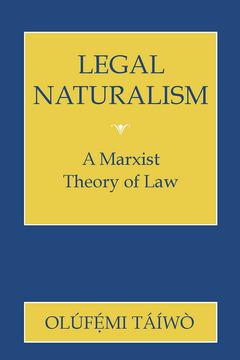
Legal Naturalism advances a clear and convincing case that Marx's theory of law is a form of natural law jurisprudence. It explicates both Marx's writings and the idea of natural law, and makes a forceful contribution to current debates on the foundations of law. Olufemi Taiwo argues that embedded in the corpus of Marxist writing is a plausible, adequate, and coherent legal theory. He describes Marx's general concept of law, which he calls "legal naturalism." For Marxism, natural law isn't a permanent verity; it refers to the basic law of a given epoch or social formation which is an essential aspect of its mode of production. Capitalist law is thus natural law in a capitalist society and is politically and morally progressive relative to the laws of preceding social formations.
Taiwo emphasizes that these formations are dialectical or dynamic, not merely static, so that the law which is naturally appropriate to a capitalist economy will embody tensions and contradictions that replicate the underlying conflicts of that economy. In addition, he discusses the enactment and reform of "positive law"—law established by government institutions—in a Marxian framework.
Płać wygodnie kartą, Klarną, Apple Pay lub Google Pay. Nie jesteś zadowolony? Zawsze masz 14-dniową gwarancję zwrotu pieniędzy. Więcej przeczytasz w naszych warunkach. Masz pytania? Napisz do nas na hello@memmo.org.
Memmo ułatwia naukę – gdziekolwiek jesteś na świecie. U nas znajdziesz podręczniki i sprytne narzędzia do nauki w jednym miejscu: streszczenia, quizy, podcasty i fiszki. A do tego Ted, Twój kumpel do nauki, który odpowie na wszystko, co Cię nurtuje. Ponad 50 000 studentów już tu się uczy – stworzone, byś uczył się szybciej i mniej stresował.