
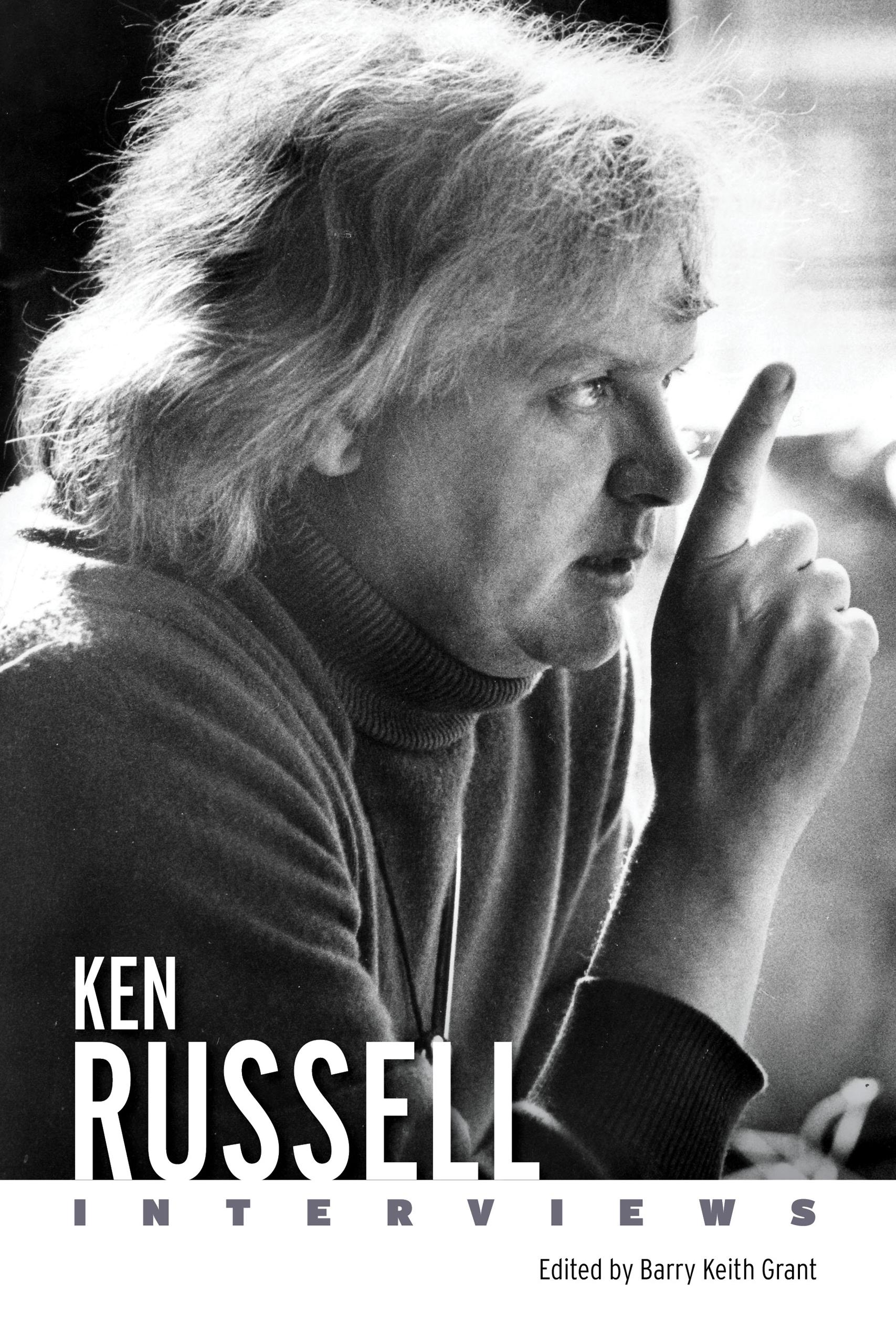
In the 1970s, British filmmaker Ken Russell (1927–2011) quickly gained a reputation as the enfant terrible of British cinema. His work, like the man himself, was regarded as flamboyant, excessive, and unrestrained. Inheriting and yet subverting the venerable mantle of British documentary, Russell did not fit comfortably in the context of a national cinema dominated by sober realism. His distinct style combined realism with fictional devices, often in audacious ways, to create the biographical “docudrama.” In Ken Russell: Interviews, the filmmaker discusses his colorful life and career, from his youth fascinated by movies to his early work in television through his feature films and his retreat to home movies.
Russell first drew notice in the early 1960s for a series of unorthodox biographical films about artists and composers. In these early television films, Russell was already exhibiting an unconventional approach to biography that combined historical fact, aesthetic interpretation, and outlandish personal vision. After the critical and commercial success of his adaptation of D. H. Lawrence’s Women in Love, Russell continued to explore the related themes of art, sexuality, and music in The Music Lovers, The Boy Friend, Mahler, Tommy, and Lisztomania. His career foundered after Valentino, however, and he found it increasingly difficult to get funding. Toward the end of his career, Russell was restricted to making movies with his own equipment, using family and friends as actors, with virtually no budget.
Throughout the ups and downs of his career, Russell alternately embraced and resented his characterization as an enfant terrible. While Russell’s comments are often meant to provoke and shock, he is articulate when discussing his films, his approach to cinema, music and composers, and, of course, his critics.
Russell first drew notice in the early 1960s for a series of unorthodox biographical films about artists and composers. In these early television films, Russell was already exhibiting an unconventional approach to biography that combined historical fact, aesthetic interpretation, and outlandish personal vision. After the critical and commercial success of his adaptation of D. H. Lawrence’s Women in Love, Russell continued to explore the related themes of art, sexuality, and music in The Music Lovers, The Boy Friend, Mahler, Tommy, and Lisztomania. His career foundered after Valentino, however, and he found it increasingly difficult to get funding. Toward the end of his career, Russell was restricted to making movies with his own equipment, using family and friends as actors, with virtually no budget.
Throughout the ups and downs of his career, Russell alternately embraced and resented his characterization as an enfant terrible. While Russell’s comments are often meant to provoke and shock, he is articulate when discussing his films, his approach to cinema, music and composers, and, of course, his critics.
Strony: 222
Kategoria: Film- & Medievetenskap
e-ISBN: 9781496851826
Waga przesyłki: 1.2 kg
Wysyłka w ciągu: 1-2 dni
Płać wygodnie kartą, Klarną, Apple Pay lub Google Pay. Nie jesteś zadowolony? Zawsze masz 14-dniową gwarancję zwrotu pieniędzy. Więcej przeczytasz w naszych warunkach. Masz pytania? Napisz do nas na hello@memmo.org.
Memmo ułatwia naukę – gdziekolwiek jesteś na świecie. U nas znajdziesz podręczniki i sprytne narzędzia do nauki w jednym miejscu: streszczenia, quizy, podcasty i fiszki. A do tego Ted, Twój kumpel do nauki, który odpowie na wszystko, co Cię nurtuje. Ponad 50 000 studentów już tu się uczy – stworzone, byś uczył się szybciej i mniej stresował.
Może Ci się spodobać
Kup książkę0