
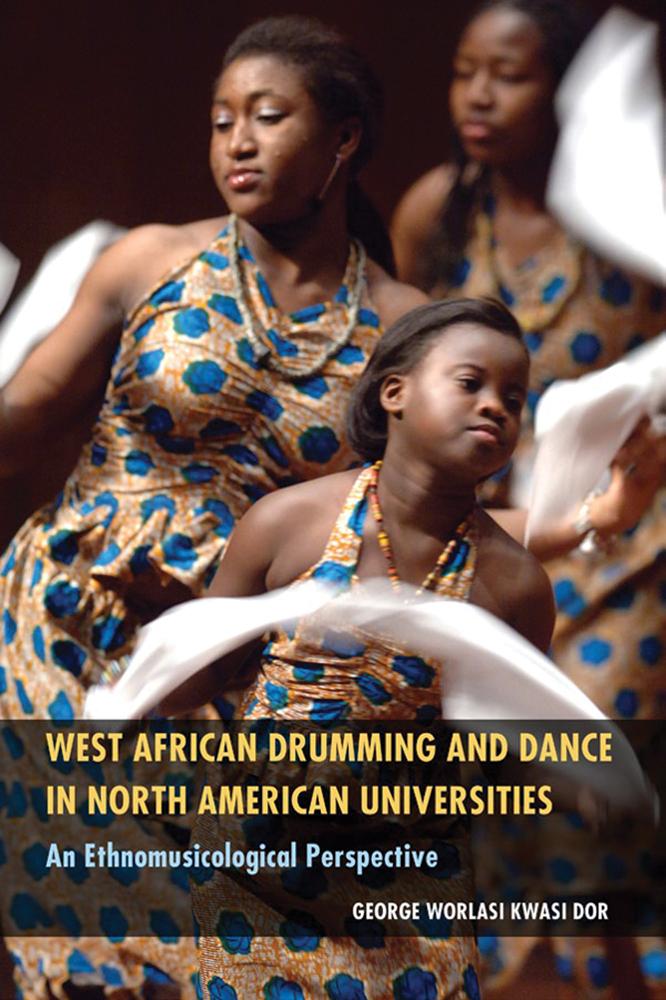
More than twenty universities and twenty other colleges in North America (USA and Canada) offer performance courses on West African ethnic dance drumming. Since its inception in 1964 at both UCLA and Columbia, West African drumming and dance has gradually developed into a vibrant campus subculture in North America. The dances most practiced in the American academy come from the ethnic groups Ewe, Akan, Ga, Dagbamba, Mande, and Wolof, thereby privileging dances mostly from Ghana, Togo, Benin, Senegal, Mali, Guinea, and Burkina Faso. This strong presence and practice of a world music ensemble in the diaspora has captured and engaged the interest of scholars, musicians, dancers, and audiences.
In the first-ever ethnographic study of West African drumming and dance in North American universities, the author documents and acknowledges ethnomusicologists, ensemble directors, students, administrators, and academic institutions for their key roles in the histories of their respective ensembles. Dor collates and shares perspectives including debates on pedagogical approaches that may be instructive as models for both current and future ensemble directors and reveals the multiple impacts that participation in an ensemble or class offers students. He also examines the interplay among historically situated structures and systems, discourse, and practice, and explores the multiple meanings that individuals and various groups of people construct from this campus activity. The study will be of value to students, directors, and scholars as an ethnographic study and as a text for teaching relevant courses in African music, African studies, ethnomusicology/world music, African diaspora studies, and other related disciplines.
In the first-ever ethnographic study of West African drumming and dance in North American universities, the author documents and acknowledges ethnomusicologists, ensemble directors, students, administrators, and academic institutions for their key roles in the histories of their respective ensembles. Dor collates and shares perspectives including debates on pedagogical approaches that may be instructive as models for both current and future ensemble directors and reveals the multiple impacts that participation in an ensemble or class offers students. He also examines the interplay among historically situated structures and systems, discourse, and practice, and explores the multiple meanings that individuals and various groups of people construct from this campus activity. The study will be of value to students, directors, and scholars as an ethnographic study and as a text for teaching relevant courses in African music, African studies, ethnomusicology/world music, African diaspora studies, and other related disciplines.
Strony: 314
Kategoria: Musikvetenskap
e-ISBN: 9781496801975
Waga przesyłki: 1.2 kg
Wysyłka w ciągu: 1-2 dni
Płać wygodnie kartą, Klarną, Apple Pay lub Google Pay. Nie jesteś zadowolony? Zawsze masz 14-dniową gwarancję zwrotu pieniędzy. Więcej przeczytasz w naszych warunkach. Masz pytania? Napisz do nas na hello@memmo.org.
Memmo ułatwia naukę – gdziekolwiek jesteś na świecie. U nas znajdziesz podręczniki i sprytne narzędzia do nauki w jednym miejscu: streszczenia, quizy, podcasty i fiszki. A do tego Ted, Twój kumpel do nauki, który odpowie na wszystko, co Cię nurtuje. Ponad 50 000 studentów już tu się uczy – stworzone, byś uczył się szybciej i mniej stresował.
Może Ci się spodobać
Kup książkę0