
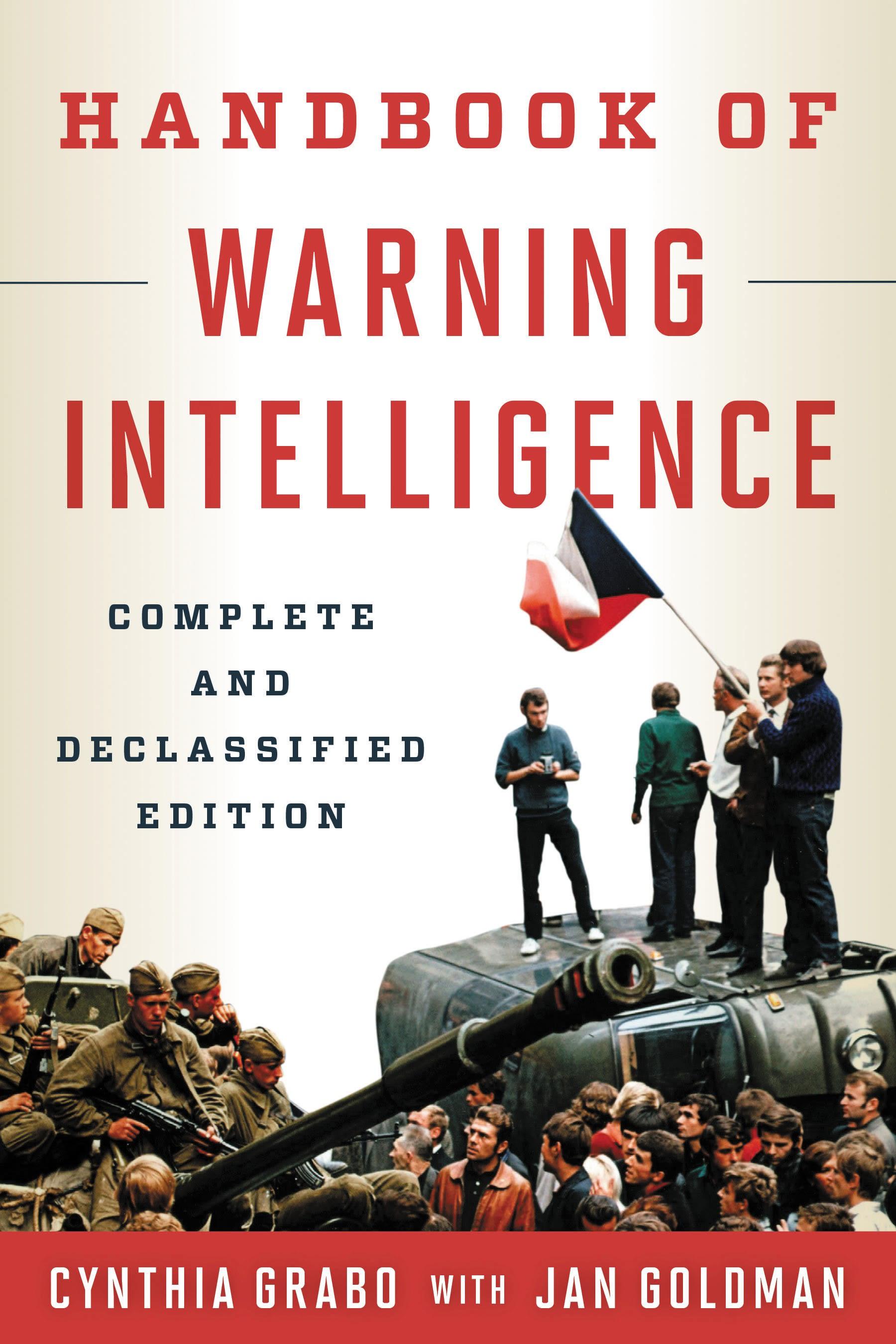
This new and final edition is a follow-up to the author’s first book, Anticipating Surprise (University Press of America, 2002) and the Handbook of Warning Intelligence (Scarecrow Press, 2010). The first book was an abridged version of Grabo’s 1972 manuscript, of which only 200 pages were allowed to be published by the government. The second book was published after it was agreed that the last 10 chapters would remain classified. These final 10 chapters have recently been released by the government and complete the manuscript as it was originally intended to be published by the author in 1972.
The Handbook of Warning Intelligence was written during the cold war and was classified for 40 years. Originally written as a manual for training intelligence analysts, it explains the fundamentals of intelligence analysis and forecasting, discusses military analysis, as well as the difficulties in understanding political, civil, and economic analysis and assessing what it means for analysts to have "warning judgment."
Much of what Grabo wrote in her book seems to appear in many of the numerous commission reports that emerged after the 9/11 attacks. However, her book was written in response to the "surprise attack" of the Soviet Union's invasion of Czechoslovakia in 1968. According to the author, that event was no surprise. And while analysts have to take some of the blame for their failure to strenuously present their case that the threat was real and imminent, what occurred was a failure by policymakers to listen to the warning intelligence reports that were written at the time.
In these last chapters, Grabo discusses scenarios where the United States will need to take action, especially describing Soviet indicators of such action. She also talks on how to influence policymakers to take, or not take, action based on intelligence. After the Soviet Union fell, the government was hesitant to release this information—especially considering what's going on with Putin today.
The Handbook of Warning Intelligence was written during the cold war and was classified for 40 years. Originally written as a manual for training intelligence analysts, it explains the fundamentals of intelligence analysis and forecasting, discusses military analysis, as well as the difficulties in understanding political, civil, and economic analysis and assessing what it means for analysts to have "warning judgment."
Much of what Grabo wrote in her book seems to appear in many of the numerous commission reports that emerged after the 9/11 attacks. However, her book was written in response to the "surprise attack" of the Soviet Union's invasion of Czechoslovakia in 1968. According to the author, that event was no surprise. And while analysts have to take some of the blame for their failure to strenuously present their case that the threat was real and imminent, what occurred was a failure by policymakers to listen to the warning intelligence reports that were written at the time.
In these last chapters, Grabo discusses scenarios where the United States will need to take action, especially describing Soviet indicators of such action. She also talks on how to influence policymakers to take, or not take, action based on intelligence. After the Soviet Union fell, the government was hesitant to release this information—especially considering what's going on with Putin today.
Płać wygodnie kartą, Klarną, Apple Pay lub Google Pay. Nie jesteś zadowolony? Zawsze masz 14-dniową gwarancję zwrotu pieniędzy. Więcej przeczytasz w naszych warunkach. Masz pytania? Napisz do nas na hello@memmo.org.
Memmo ułatwia naukę – gdziekolwiek jesteś na świecie. U nas znajdziesz podręczniki i sprytne narzędzia do nauki w jednym miejscu: streszczenia, quizy, podcasty i fiszki. A do tego Ted, Twój kumpel do nauki, który odpowie na wszystko, co Cię nurtuje. Ponad 50 000 studentów już tu się uczy – stworzone, byś uczył się szybciej i mniej stresował.