
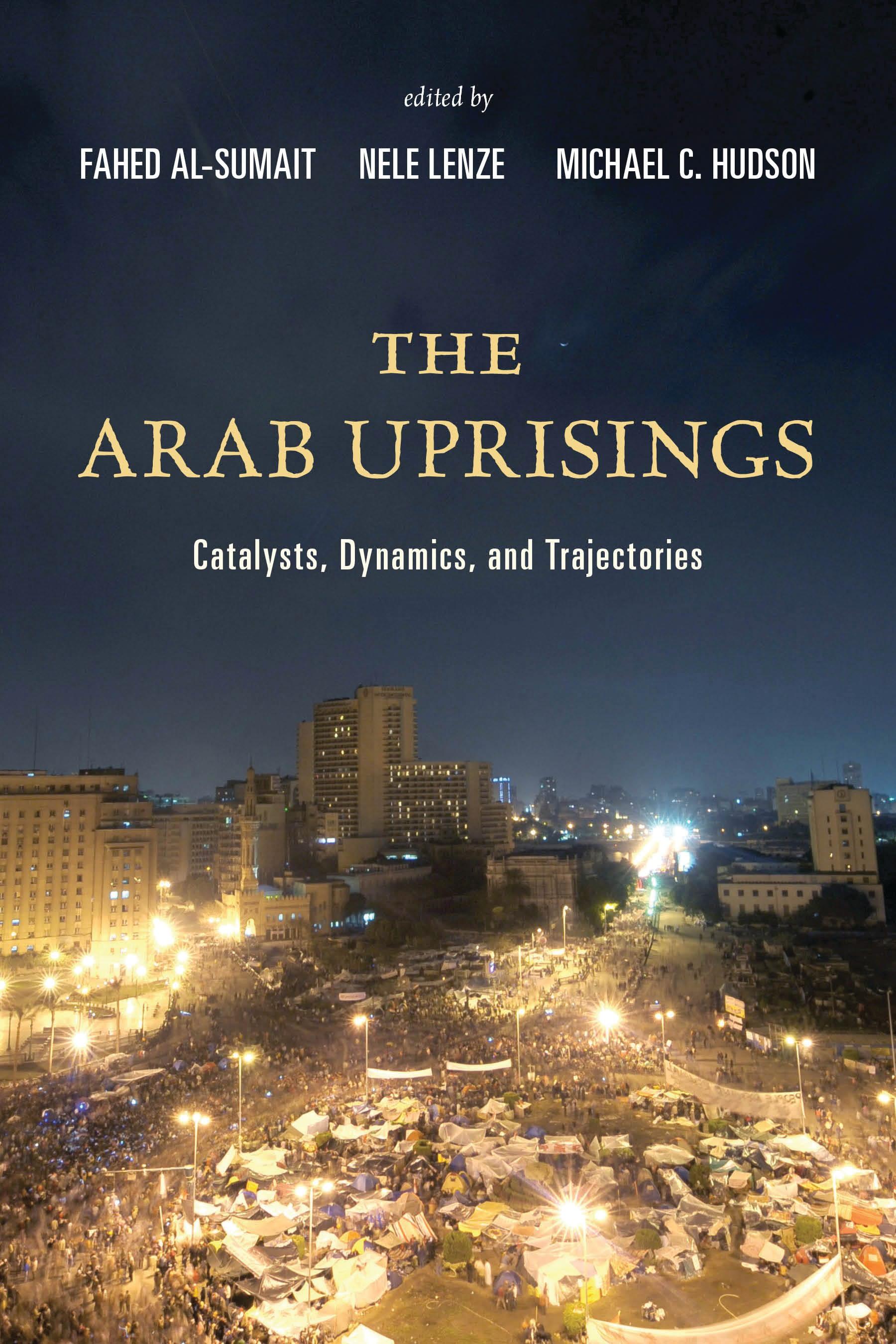
The uprisings of 2011 have radically altered the political, economic, and social landscapes of the Middle East and North Africa. A clearer view of the recent past now provides greater perspectives on the causes and the consequences of these events. This collection of essays challenges the common tendency of applying the dominant frame of “Arab Spring” to explain contemporary politics of the Middle East. Numerous debates about the utility of the “Arab Spring” metaphor already exist, contesting such issues as its foreign origins or its temporal and optimistic implications. It further has the negative and significant side effect of implying a singularity to these events in a manner that often defies the varied conditions on the ground. This is why the term “Arab Uprisings” is used here as the organizing frame to address numerous socio-cultural, economic, political, experiential, and communicative aspects of the uprisings.
This text is organized around three themes: origins, experiences, and trajectories. The first section addresses catalyzing factors that help explain the emergence of the uprisings from various political, economic, and socio-cultural perspectives. The second section examines the functions and responses of diverse people, institutions, and ideologies during the initial years of the uprisings. It includes an in-depth case study on women’s changing political situation in the catalyzing country of Tunisia, as well as discussions about the roles of political Islam, new mass media, and social networks in these rapidly changing contexts. The third section discusses cross-national implications and the multitude of repercussion the uprisings are having on the global system.
Using an interdisciplinary approach with contrasting theoretical and methodological orientations, the global experts who contributed the chapters explore various theoretical approaches, juxtaposing them with comparative surveys and in-depth case studies. They show that after the initial euphoria (or dread) that surrounded the uprisings, a transitional and transformative period in the Middle East has come that requires thorough observation and analysis.
This text is organized around three themes: origins, experiences, and trajectories. The first section addresses catalyzing factors that help explain the emergence of the uprisings from various political, economic, and socio-cultural perspectives. The second section examines the functions and responses of diverse people, institutions, and ideologies during the initial years of the uprisings. It includes an in-depth case study on women’s changing political situation in the catalyzing country of Tunisia, as well as discussions about the roles of political Islam, new mass media, and social networks in these rapidly changing contexts. The third section discusses cross-national implications and the multitude of repercussion the uprisings are having on the global system.
Using an interdisciplinary approach with contrasting theoretical and methodological orientations, the global experts who contributed the chapters explore various theoretical approaches, juxtaposing them with comparative surveys and in-depth case studies. They show that after the initial euphoria (or dread) that surrounded the uprisings, a transitional and transformative period in the Middle East has come that requires thorough observation and analysis.
Strony: 256
Kategoria: Statsvetenskap & Politik
e-ISBN: 9781442239029
Waga przesyłki: 1.2 kg
Wysyłka w ciągu: 1-2 dni
Płać wygodnie kartą, Klarną, Apple Pay lub Google Pay. Nie jesteś zadowolony? Zawsze masz 14-dniową gwarancję zwrotu pieniędzy. Więcej przeczytasz w naszych warunkach. Masz pytania? Napisz do nas na hello@memmo.org.
Memmo ułatwia naukę – gdziekolwiek jesteś na świecie. U nas znajdziesz podręczniki i sprytne narzędzia do nauki w jednym miejscu: streszczenia, quizy, podcasty i fiszki. A do tego Ted, Twój kumpel do nauki, który odpowie na wszystko, co Cię nurtuje. Ponad 50 000 studentów już tu się uczy – stworzone, byś uczył się szybciej i mniej stresował.