
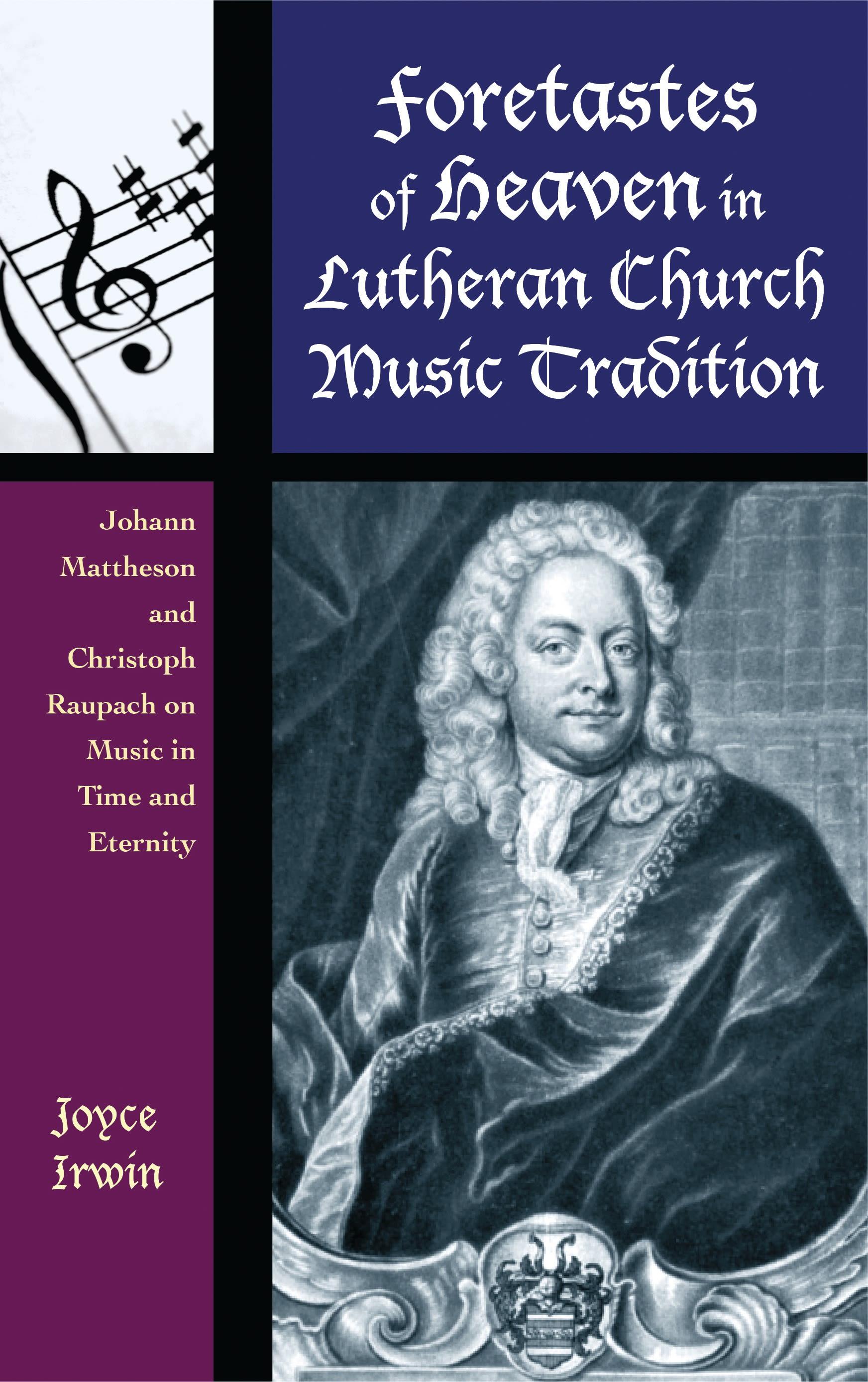
In the two centuries after Martin Luther’s affirmation that music stood second only to theology, Lutheran theologians and musicians formulated a theological defense of music that validated this exalted status. Against Calvinist rivals and Pietist critics, the orthodox Lutheran position further claimed that both instrumental and vocal music were commanded by God. Joyce Irwin’s earlier work, Neither Voice nor Heart Alone: German Lutheran Theology of Music in the Age of the Baroque, traced this development in Lutheran theological thought.
In this current work, Foretastes of Heavenly Music: Johann Mattheson and Christoph Raupach on Music in Time and Eternity, Irwin provides translations and commentary for two eighteenth-century texts that illuminate the musico-theological foundation underlying the work of Lutheran composers such as Bach and Telemann. A Truth Lover’s Clear Reasonings on Which the Correct Use of Music Rests (1717) by Christoph Raupach, with an introduction by Johann Mattheson, serves as a cumulative statement of Lutheran advocacy of music. Mattheson’s Affirmation of Heavenly Music (1747) goes a step further in defending the reality of music in heaven and even the ultimate superiority of music over theology and sermons.
Irwin’s introduction traces the centrality of Mattheson’s belief in heavenly music throughout the course of his life, even while he was writing works of music theory that earned him a reputation as an Enlightenment thinker. Though influenced by Enlightenment philosophy, specifically British empiricism, he rejected the rationalist philosophies of his German contemporaries and expressed no sympathy for the emerging school of biblical criticism.
This work is ideal for music historians, Bach scholars, theologians, and researchers in the field of sacred music.
In this current work, Foretastes of Heavenly Music: Johann Mattheson and Christoph Raupach on Music in Time and Eternity, Irwin provides translations and commentary for two eighteenth-century texts that illuminate the musico-theological foundation underlying the work of Lutheran composers such as Bach and Telemann. A Truth Lover’s Clear Reasonings on Which the Correct Use of Music Rests (1717) by Christoph Raupach, with an introduction by Johann Mattheson, serves as a cumulative statement of Lutheran advocacy of music. Mattheson’s Affirmation of Heavenly Music (1747) goes a step further in defending the reality of music in heaven and even the ultimate superiority of music over theology and sermons.
Irwin’s introduction traces the centrality of Mattheson’s belief in heavenly music throughout the course of his life, even while he was writing works of music theory that earned him a reputation as an Enlightenment thinker. Though influenced by Enlightenment philosophy, specifically British empiricism, he rejected the rationalist philosophies of his German contemporaries and expressed no sympathy for the emerging school of biblical criticism.
This work is ideal for music historians, Bach scholars, theologians, and researchers in the field of sacred music.
Strony: 214
Kategoria: Musikvetenskap
e-ISBN: 9781442232648
Waga przesyłki: 1.2 kg
Wysyłka w ciągu: 1-2 dni
Płać wygodnie kartą, Klarną, Apple Pay lub Google Pay. Nie jesteś zadowolony? Zawsze masz 14-dniową gwarancję zwrotu pieniędzy. Więcej przeczytasz w naszych warunkach. Masz pytania? Napisz do nas na hello@memmo.org.
Memmo ułatwia naukę – gdziekolwiek jesteś na świecie. U nas znajdziesz podręczniki i sprytne narzędzia do nauki w jednym miejscu: streszczenia, quizy, podcasty i fiszki. A do tego Ted, Twój kumpel do nauki, który odpowie na wszystko, co Cię nurtuje. Ponad 50 000 studentów już tu się uczy – stworzone, byś uczył się szybciej i mniej stresował.