
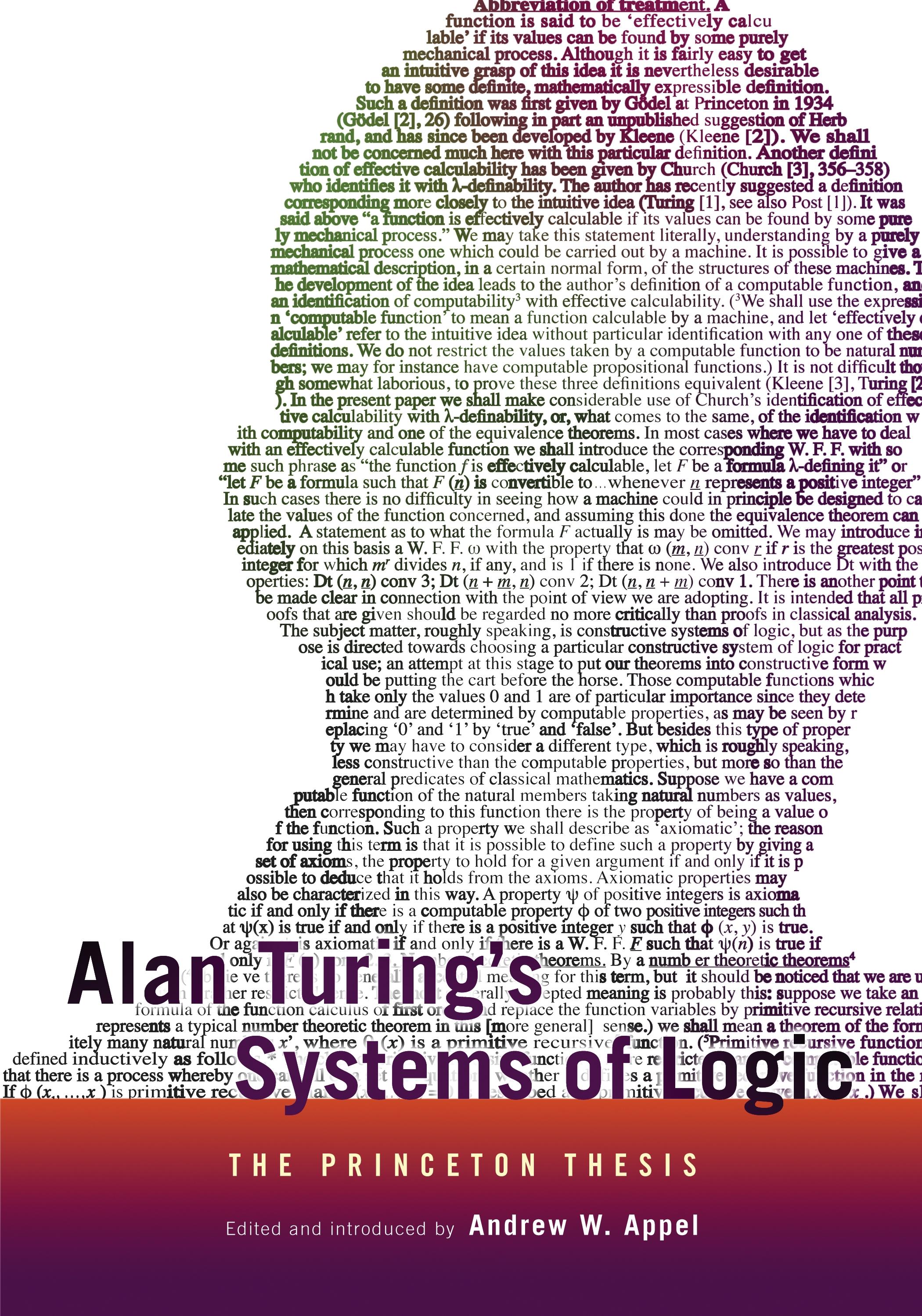
A facsimile edition of Alan Turing's influential Princeton thesis
Between inventing the concept of a universal computer in 1936 and breaking the German Enigma code during World War II, Alan Turing (1912–1954), the British founder of computer science and artificial intelligence, came to Princeton University to study mathematical logic. Some of the greatest logicians in the world—including Alonzo Church, Kurt Gödel, John von Neumann, and Stephen Kleene—were at Princeton in the 1930s, and they were working on ideas that would lay the groundwork for what would become known as computer science. This book presents a facsimile of the original typescript of Turing's fascinating and influential 1938 Princeton PhD thesis, one of the key documents in the history of mathematics and computer science. The book also features essays by Andrew Appel and Solomon Feferman that explain the still-unfolding significance of the ideas Turing developed at Princeton.
A work of philosophy as well as mathematics, Turing's thesis envisions a practical goal—a logical system to formalize mathematical proofs so they can be checked mechanically. If every step of a theorem could be verified mechanically, the burden on intuition would be limited to the axioms. Turing's point, as Appel writes, is that "mathematical reasoning can be done, and should be done, in mechanizable formal logic." Turing's vision of "constructive systems of logic for practical use" has become reality: in the twenty-first century, automated "formal methods" are now routine.
Presented here in its original form, this fascinating thesis is one of the key documents in the history of mathematics and computer science.
Płać wygodnie kartą, Klarną, Apple Pay lub Google Pay. Nie jesteś zadowolony? Zawsze masz 14-dniową gwarancję zwrotu pieniędzy. Więcej przeczytasz w naszych warunkach. Masz pytania? Napisz do nas na hello@memmo.org.
Memmo ułatwia naukę – gdziekolwiek jesteś na świecie. U nas znajdziesz podręczniki i sprytne narzędzia do nauki w jednym miejscu: streszczenia, quizy, podcasty i fiszki. A do tego Ted, Twój kumpel do nauki, który odpowie na wszystko, co Cię nurtuje. Ponad 50 000 studentów już tu się uczy – stworzone, byś uczył się szybciej i mniej stresował.