
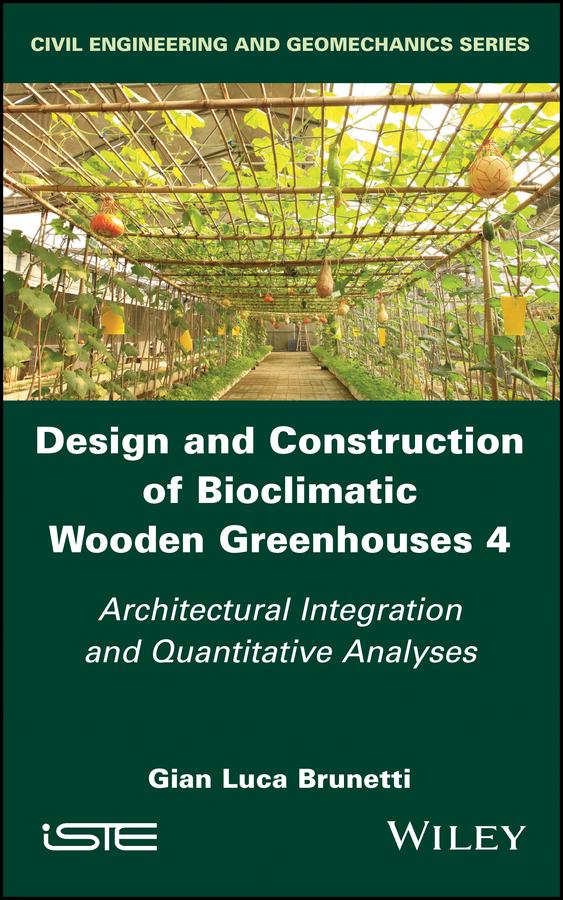
This book is the fourth of four dealing with bioclimatic design and construction by focusing on the most basic and polyvalent of modern environmental systems: the bioclimatic greenhouse, the "Swiss-army chainsaw" of architecture. More specifically, this fourth volume focuses on architectural integration, environmental prediction and how to simulate and structurally size a bioclimatic wooden greenhouse. In more general terms, it helps us to consider how to design and build the structure of bioclimatic, low-energy architecture, with low environmental impact.
This multi-volume book covers both free-standing greenhouses that can naturally heat and cool themselves, and lean-to greenhouses that support the natural heating and cooling of buildings; this includes both agricultural greenhouses and greenhouses suited to host people. As a result, it is a trans-disciplinary work deriving its areas of concern from a broad range of study areas, spanning from environmental, to constructional, to structural, drawing the clarity of the approach from the fact that the topics are presented by a single author with a single voice and a designer's mindset.
To achieve this, the book adopts a composite set of explanatory strategies and communication registers – including extensive support by 3D construction drawings and examples – and presents not only stateof-the-art solutions, but also experimental ones.
Płać wygodnie kartą, Klarną, Apple Pay lub Google Pay. Nie jesteś zadowolony? Zawsze masz 14-dniową gwarancję zwrotu pieniędzy. Więcej przeczytasz w naszych warunkach. Masz pytania? Napisz do nas na hello@memmo.org.
Memmo ułatwia naukę – gdziekolwiek jesteś na świecie. U nas znajdziesz podręczniki i sprytne narzędzia do nauki w jednym miejscu: streszczenia, quizy, podcasty i fiszki. A do tego Ted, Twój kumpel do nauki, który odpowie na wszystko, co Cię nurtuje. Ponad 50 000 studentów już tu się uczy – stworzone, byś uczył się szybciej i mniej stresował.