
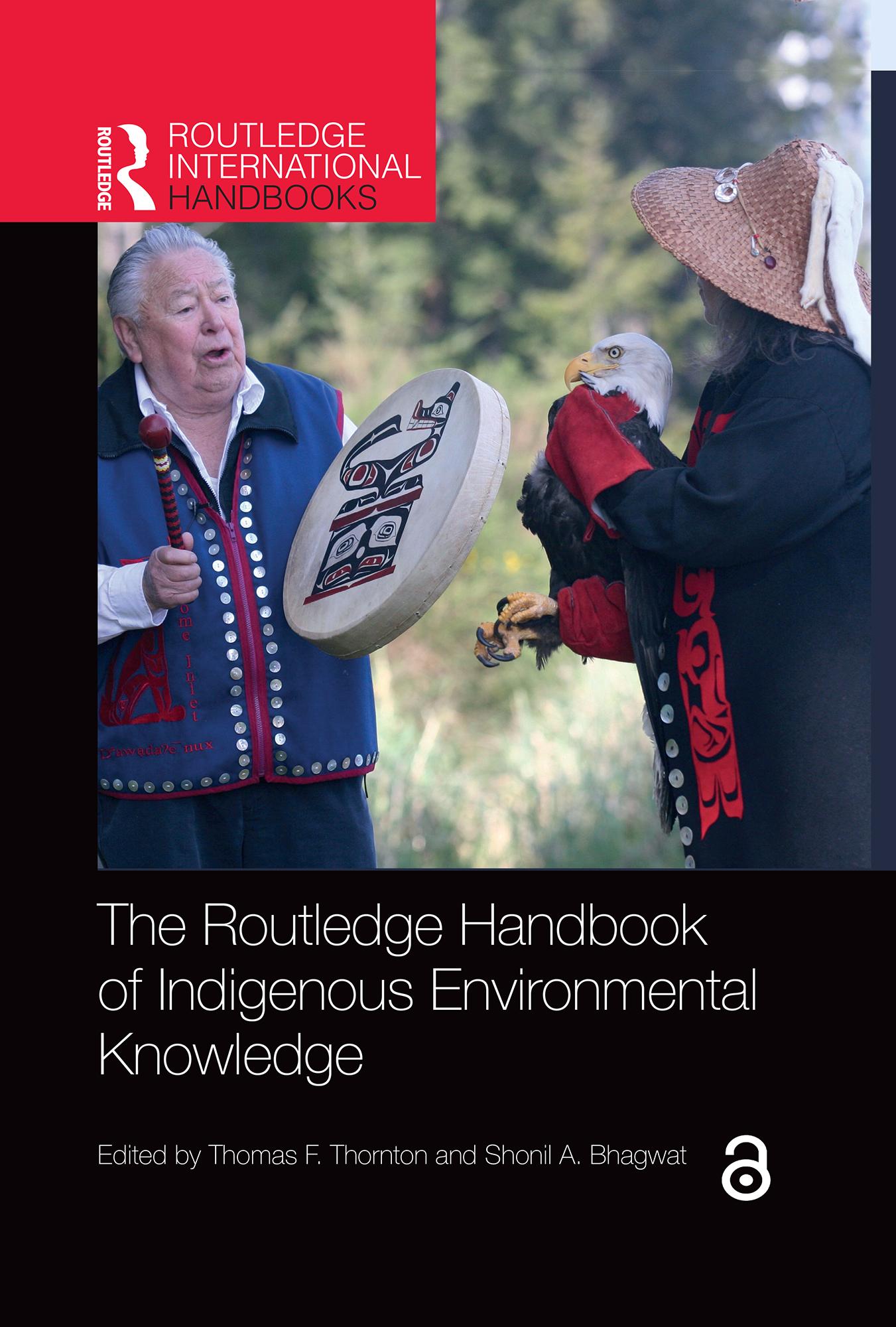
This volume provides an overview of key themes in Indigenous Environmental Knowledge (IEK) and anchors them with brief but well-grounded empirical case studies of relevance for each of these themes, drawn from bioculturally diverse areas around the world. It provides an incisive, cutting-edge overview of the conceptual and philosophical issues, while providing constructive examples of how IEK studies have been implemented to beneficial effect in ecological restoration, stewardship, and governance schemes.
Collectively, the chapters in the Routledge Handbook of Indigenous Environmental Knowledge cover Indigenous Knowledge not only in a wide range of cultures and livelihood contexts, but also in a wide range of environments, including drylands, savannah grassland, tropical forests, mountain landscapes, temperate and boreal forests, Pacific and Indian Ocean islands, and coastal environments. The chapters discuss the complexities and nuances of Indigenous cosmologies and ethno-metaphysics and the treatment and incorporation of IEK in local, national, and international environmental policies. Taken together, the chapters in this volume make a strong case for the potential of Indigenous Knowledge in addressing today’s local and global environmental challenges, especially when approached from a perspective of appreciative inquiry, using cross-cultural methods and ethical, collaborative approaches which limit bias and inappropriate extraction of IEK.
The book is a guide for graduate and advanced undergraduate teaching, and a key reference for academics in development studies, environmental studies, geography, anthropology, and beyond, as well as anyone with an interest in Indigenous Environmental Knowledge.
Chapters 10 and 23 of this book are freely available as a downloadable Open Access PDF at http://www.taylorfrancis.com under a Creative Commons Attribution-Non Commercial-No Derivatives (CC-BY-NC-ND) 4.0 license.
Płać wygodnie kartą, Klarną, Apple Pay lub Google Pay. Nie jesteś zadowolony? Zawsze masz 14-dniową gwarancję zwrotu pieniędzy. Więcej przeczytasz w naszych warunkach. Masz pytania? Napisz do nas na hello@memmo.org.
Memmo ułatwia naukę – gdziekolwiek jesteś na świecie. U nas znajdziesz podręczniki i sprytne narzędzia do nauki w jednym miejscu: streszczenia, quizy, podcasty i fiszki. A do tego Ted, Twój kumpel do nauki, który odpowie na wszystko, co Cię nurtuje. Ponad 50 000 studentów już tu się uczy – stworzone, byś uczył się szybciej i mniej stresował.