
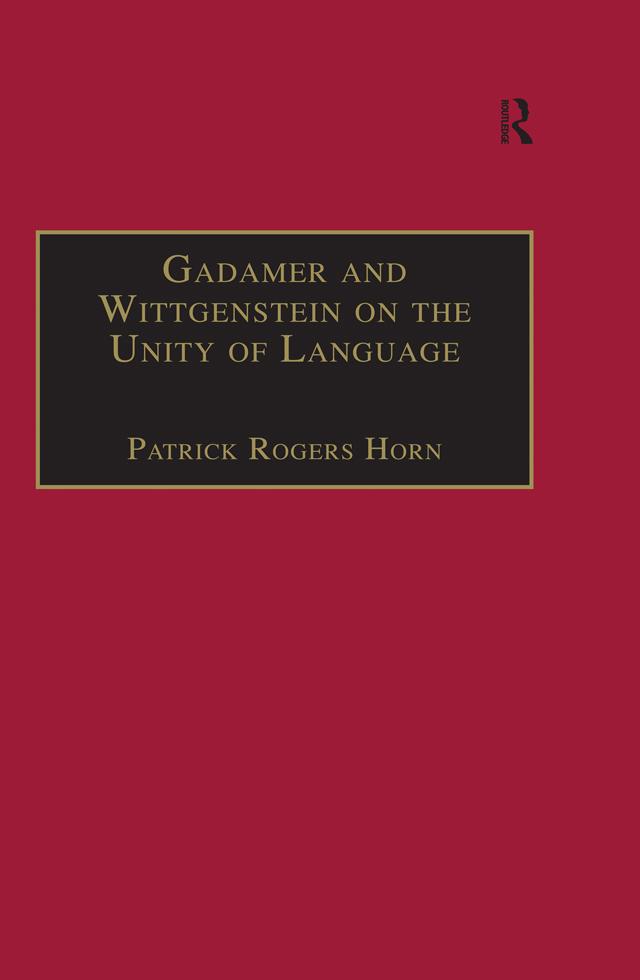
In this innovative comparison of Gadamer and Wittgenstein, the author explores their common concern with the relation of language to reality. Patrick Horn's starting point is the widely accepted view that both philosophers rejected a certain metaphysical account of that relation in which reality determines the nature of language. Horn proceeds to argue that Gadamer never completely escaped metaphysical assumptions in his search for the unity of language. In this respect, argues Horn, Gadamer's work is nearer to the earlier rather than to the later Wittgenstein. The final chapter of the book highlights the work of Wittgenstein’s pupil Rush Rhees, who shows that Wittgenstein's own later emphasis on language games, while doing justice to the variety of language, does less than justice to the dialogical relation between speakers of a language, wherein the unity of language resides. Contrasting Rhees's account of the unity of language with those given by Gadamer and the early Wittgenstein brings out the importance of understanding reality in terms of the life that people share rather than in terms of what philosophers say about reality.
Płać wygodnie kartą, Klarną, Apple Pay lub Google Pay. Nie jesteś zadowolony? Zawsze masz 14-dniową gwarancję zwrotu pieniędzy. Więcej przeczytasz w naszych warunkach. Masz pytania? Napisz do nas na hello@memmo.org.
Memmo ułatwia naukę – gdziekolwiek jesteś na świecie. U nas znajdziesz podręczniki i sprytne narzędzia do nauki w jednym miejscu: streszczenia, quizy, podcasty i fiszki. A do tego Ted, Twój kumpel do nauki, który odpowie na wszystko, co Cię nurtuje. Ponad 50 000 studentów już tu się uczy – stworzone, byś uczył się szybciej i mniej stresował.
Może Ci się spodobać
Kup książkę0