
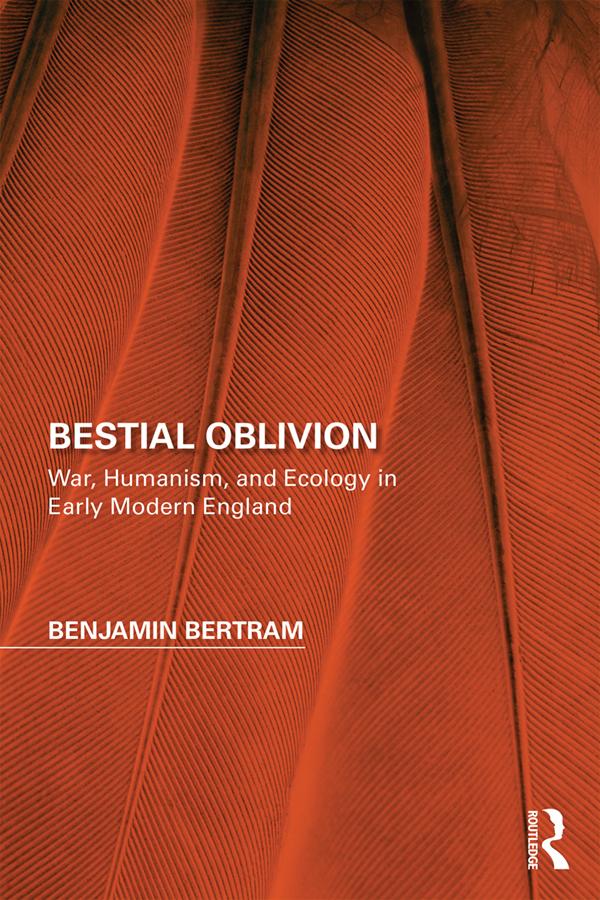
Although war is a heterogeneous assemblage of the human and nonhuman, it nevertheless builds the illusion of human autonomy and singularity. Focusing on war and ecology, a neglected topic in early modern ecocriticism, Bestial Oblivion: War, Humanism, and Ecology in Early Modern England shows how warfare unsettles ideas of the human, yet ultimately contributes to, and is then perpetuated by, anthropocentrism. Bertram’s study of early modern warfare’s impact on human-animal and human-technology relationships draws upon posthumanist theory, animal studies, and the new materialisms, focusing on responses to the Anglo-Spanish War, the Italian Wars, the Wars of Religion, the colonization of Ireland, and Jacobean “peace.” The monograph examines a wide range of texts—essays, drama, military treatises, paintings, poetry, engravings, war reports, travel narratives—and authors—Erasmus, Machiavelli, Digges, Shakespeare, Marlowe, Coryate, Bacon—to show how an intricate web of perpetual war altered the perception of the physical environment as well as the ideologies and practices establishing what it meant to be human.
Płać wygodnie kartą, Klarną, Apple Pay lub Google Pay. Nie jesteś zadowolony? Zawsze masz 14-dniową gwarancję zwrotu pieniędzy. Więcej przeczytasz w naszych warunkach. Masz pytania? Napisz do nas na hello@memmo.org.
Memmo ułatwia naukę – gdziekolwiek jesteś na świecie. U nas znajdziesz podręczniki i sprytne narzędzia do nauki w jednym miejscu: streszczenia, quizy, podcasty i fiszki. A do tego Ted, Twój kumpel do nauki, który odpowie na wszystko, co Cię nurtuje. Ponad 50 000 studentów już tu się uczy – stworzone, byś uczył się szybciej i mniej stresował.