
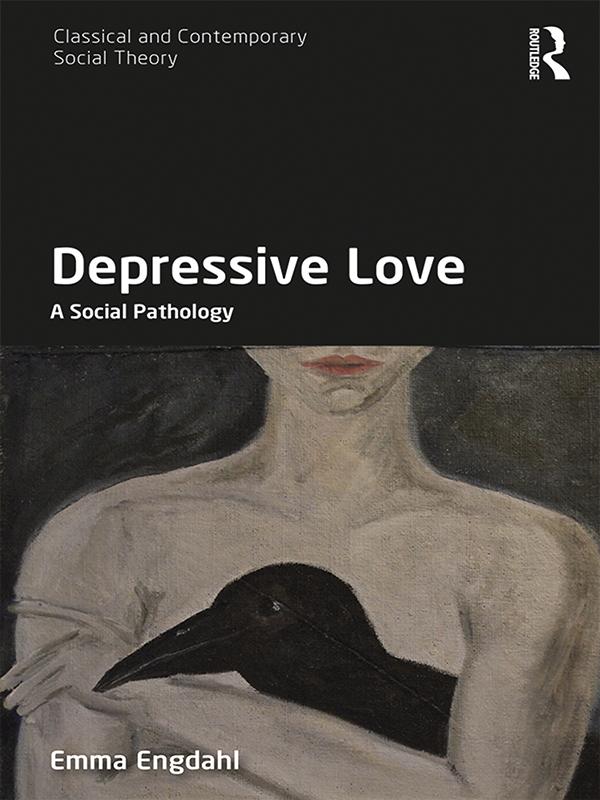
Love and depression are key elements in the cultural script of emotions or affectual life within contemporary Western society, and the two have become intertwined to such an extent that it is informative to talk about depressive love. Indeed, the most common source of depression is intimate relationships, in which one partner is not recognised by the other as being in need or worthy of loving care. This book addresses the question of how it is possible for opposite emotional experiences such as love and depression to appear simultaneously, empirically documenting the phenomenon of depressive love and its implications through studies of art, including music, literature and photography, and the experiences of everyday life, by way of interviews and the analysis of e-mail-, sms-, messenger-correspondence, and other new media spaces. Engaging with a range of sociological, psychoanalytic and philosophical theories of love, depression and emotion, including the work of Simmel, Alberoni, Barthes, Hochschild, Giddens, Luhmann, Beck and Beck-Gernsheim, Illouz, Bauman, Hegel, Honneth, Ehrenberg, Han, Lévinas, Sartre, Freud, Lacan, and Kristeva, to name but a few, the author examines the ways in which depressive love is expressed in modern society, asking whether it is a new phenomenon and confined to the West and if not, what is distinctive about depressive love and its associated (dys)functions in contemporary Western society. An empirically rich and theoretically broad study of depressive love as a sign of our times, this book will appeal to scholars and students of social theory and the sociology and philosophy of emotion and interpersonal relationships.
Płać wygodnie kartą, Klarną, Apple Pay lub Google Pay. Nie jesteś zadowolony? Zawsze masz 14-dniową gwarancję zwrotu pieniędzy. Więcej przeczytasz w naszych warunkach. Masz pytania? Napisz do nas na hello@memmo.org.
Memmo ułatwia naukę – gdziekolwiek jesteś na świecie. U nas znajdziesz podręczniki i sprytne narzędzia do nauki w jednym miejscu: streszczenia, quizy, podcasty i fiszki. A do tego Ted, Twój kumpel do nauki, który odpowie na wszystko, co Cię nurtuje. Ponad 50 000 studentów już tu się uczy – stworzone, byś uczył się szybciej i mniej stresował.