
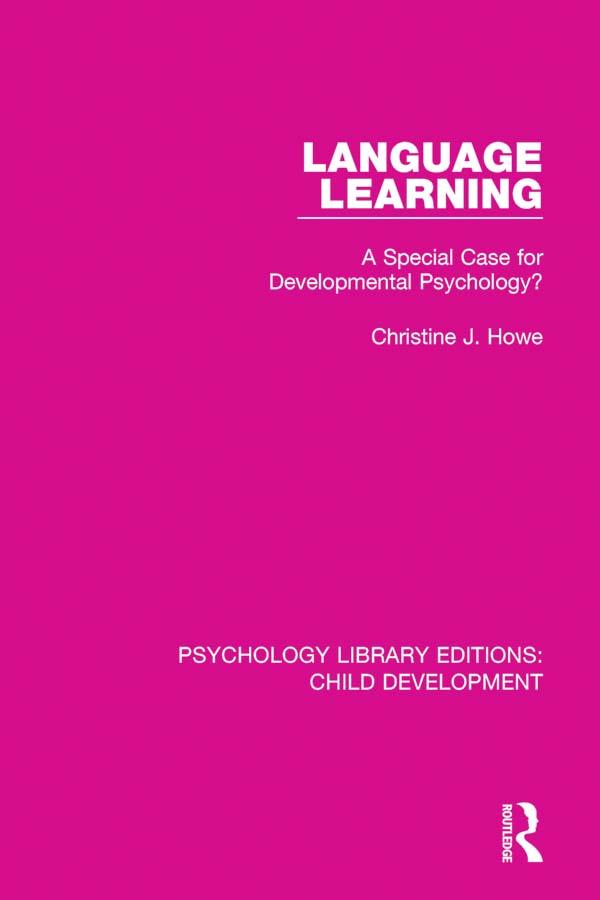
Originally published in 1993, the starting place for this book is the notion, current in the literature for around 30 years at that time, that children could not learn their native language without substantial innate knowledge of its grammatical structure. It is argued that the notion is as problematic for contemporary theories of development as it was for theories of the past. Accepting this, the book attempts an in-depth study of the notions credibility.
Central to the book’s argument is the conclusion that the innateness hypothesis runs into two major problems. Firstly, its proponents are too ready to treat children as embryonic linguists, concerned with the representation of sentences as an end in itself. A more realistic approach would be to regard children as communication engineers, storing sentences to optimize the production and retrieval of meaning. Secondly, even when the communication analogy is adopted, it is glibly assumed that the meanings children impute will be the ones adults intend. One of the book’s major contentions is that a careful reading of contemporary research suggests that the meanings may differ considerably.
Identifying such problems, the book considers how development should proceed, given learning along communication lines and a more plausible analysis of meaning. It makes detailed predictions about what would be anticipated given no innate knowledge of grammar. Focusing on English but giving full acknowledgement to cross-linguistic research, it concludes that the predictions are consistent with both the known timescale of learning and the established facts about children’s knowledge. Thus the book aspires to a serious challenge to the innateness hypothesis via, as its final chapter will argue, a model which is much more reassuring to psychological theory.
Płać wygodnie kartą, Klarną, Apple Pay lub Google Pay. Nie jesteś zadowolony? Zawsze masz 14-dniową gwarancję zwrotu pieniędzy. Więcej przeczytasz w naszych warunkach. Masz pytania? Napisz do nas na hello@memmo.org.
Memmo ułatwia naukę – gdziekolwiek jesteś na świecie. U nas znajdziesz podręczniki i sprytne narzędzia do nauki w jednym miejscu: streszczenia, quizy, podcasty i fiszki. A do tego Ted, Twój kumpel do nauki, który odpowie na wszystko, co Cię nurtuje. Ponad 50 000 studentów już tu się uczy – stworzone, byś uczył się szybciej i mniej stresował.