
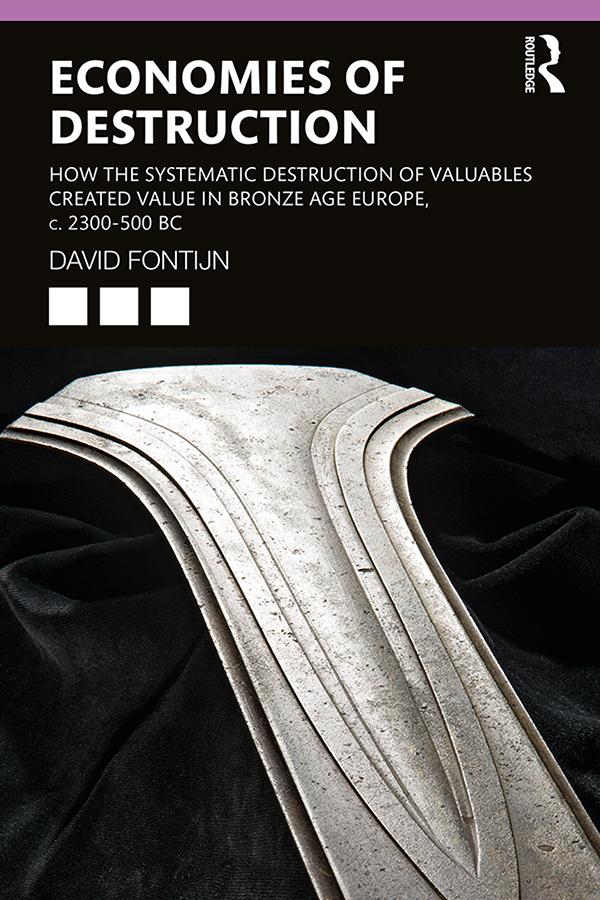
Why do people destroy objects and materials that are important to them? This book aims to make sense of this fascinating, yet puzzling social practice by focusing on a period in history in which such destructive behaviour reached unseen heights and complexity: the Bronze Age and Early Iron Age in Europe (c. 2300–500 BC).
This period is often seen as the time in which a ‘familiar’ Europe took shape due to the rise of a metal-based economy. But it was also during the Bronze Age that massive amounts of scarce and recyclable metal were deliberately buried in the landscape and never taken out again. This systematic deposition of metalwork sits uneasily with our prevailing perception of the Bronze Age as the first ‘rational-economic’ period in history – and therewith – of ourselves. Taking the patterned archaeological evidence of these seemingly un-economic metalwork depositions at face value, it is shown that the ‘un-economic’ giving-up of metal valuables was an integral part of what a Bronze Age ‘economy’ was about. Based on case studies from Bronze Age Europe, this book attempts to reconcile the seemingly conflicting political and cultural approaches that are currently used to understand this pivotal period in Europe’s deep history. It seems that to achieve something in society, something else must be given up.
Using theories from economic anthropology, this book argues that – paradoxically – giving up that which was valuable created value. It will be invaluable to scholars and archaeologists interested in the Bronze Age, ancient economies, and a new angle on metalwork depositions.
Płać wygodnie kartą, Klarną, Apple Pay lub Google Pay. Nie jesteś zadowolony? Zawsze masz 14-dniową gwarancję zwrotu pieniędzy. Więcej przeczytasz w naszych warunkach. Masz pytania? Napisz do nas na hello@memmo.org.
Memmo ułatwia naukę – gdziekolwiek jesteś na świecie. U nas znajdziesz podręczniki i sprytne narzędzia do nauki w jednym miejscu: streszczenia, quizy, podcasty i fiszki. A do tego Ted, Twój kumpel do nauki, który odpowie na wszystko, co Cię nurtuje. Ponad 50 000 studentów już tu się uczy – stworzone, byś uczył się szybciej i mniej stresował.