
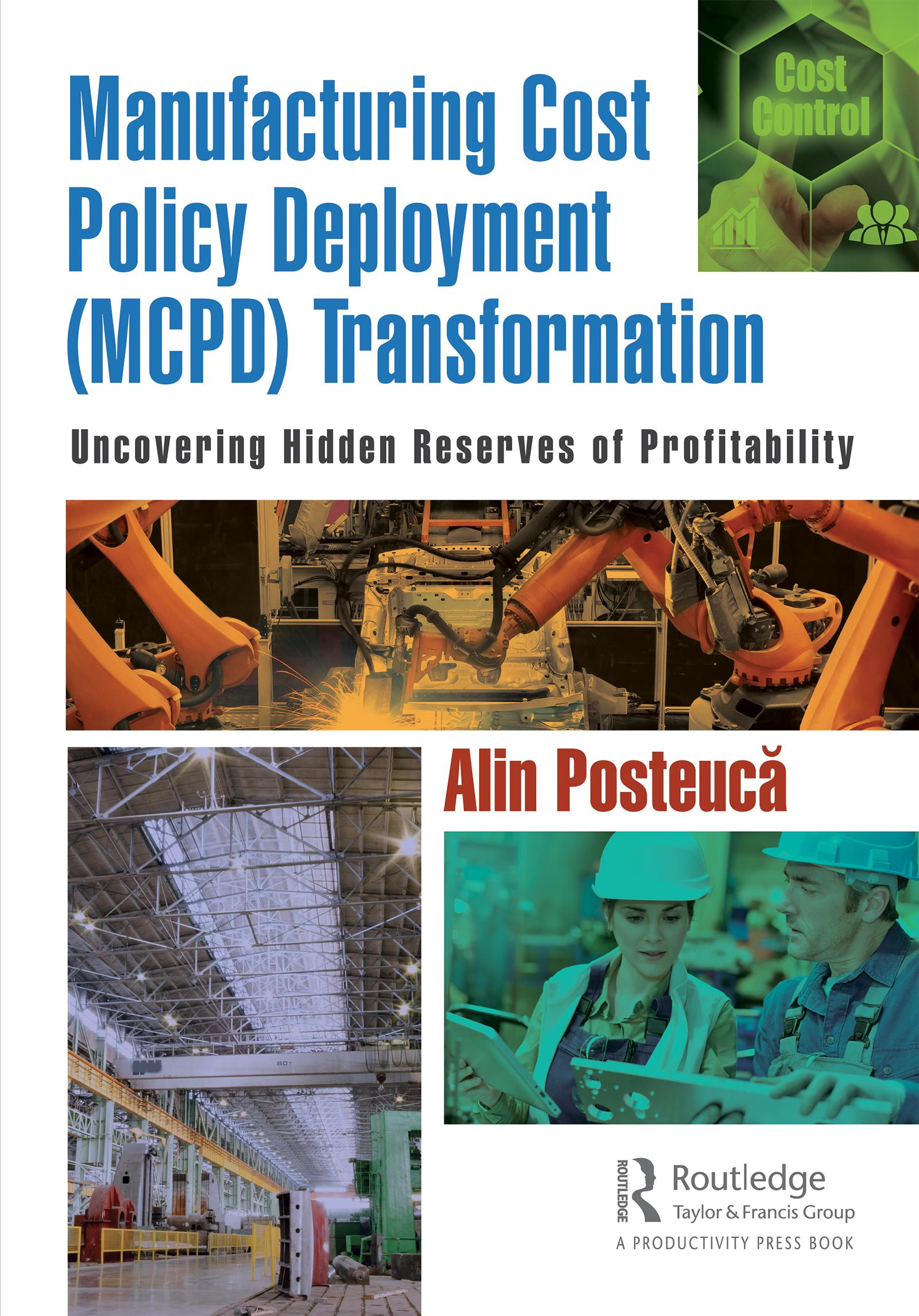
Achieving a long-term acceptable level of manufacturing profitability through productivity requires the total commitment of management teams and all staff in any manufacturing company and beyond.
Awareness and continuous improvement of manufacturing costs behind losses and waste is the core goal of the Manufacturing Cost Policy Deployment (MCPD). Achieving this goal will continually uncover the hidden reserves of profitability through a harmonious transformation of the manufacturing flow, coordinated by the continuous need to improve manufacturing costs. Setting annual targets and means for manufacturing costs improvement (more exactly for costs of losses and waste, and the exact fulfillment of these) requires mobilization of all people in the company to carry out systematic improvement activities (kaizen) and systemic improvement actions (kaikaku) of the processes of each product family cost. The MCPD system was born out of careful observation of the challenges, principles, and phenomena of manufacturing companies and the profound discussions with the people in these companies at all levels.
Manufacturing Cost Policy Deployment (MCPD) Transformation: Uncovering Hidden Reserves of Profitability is organized in three sections. The first section presents the concept and the need for an MCPD system from a managerial perspective. In the second section, the transformation of manufacturing companies through the MCPD system is presented, more precisely the details of the initial steps of the implementation of the MCPD, the three phases and the seven steps of the MCPD, and the elements necessary for a constant and consistent application of the MCPD. In the last section, there are two examples of the MCPD implementation in two different types of industries, namely, manufacturing and assembly industry and process industry, and two case studies for the improvement of manufacturing costs for each (cost of equipment setup loss, using kaizenshiro; replacement of bottleneck equipment and associated costs of losses, using kaikaku; cost of quality losses with improving operators’ skills to sustain quality, using kaizen; and cost problem solving with the consumption of lubricants for one of the equipment, using A3).
Płać wygodnie kartą, Klarną, Apple Pay lub Google Pay. Nie jesteś zadowolony? Zawsze masz 14-dniową gwarancję zwrotu pieniędzy. Więcej przeczytasz w naszych warunkach. Masz pytania? Napisz do nas na hello@memmo.org.
Memmo ułatwia naukę – gdziekolwiek jesteś na świecie. U nas znajdziesz podręczniki i sprytne narzędzia do nauki w jednym miejscu: streszczenia, quizy, podcasty i fiszki. A do tego Ted, Twój kumpel do nauki, który odpowie na wszystko, co Cię nurtuje. Ponad 50 000 studentów już tu się uczy – stworzone, byś uczył się szybciej i mniej stresował.