
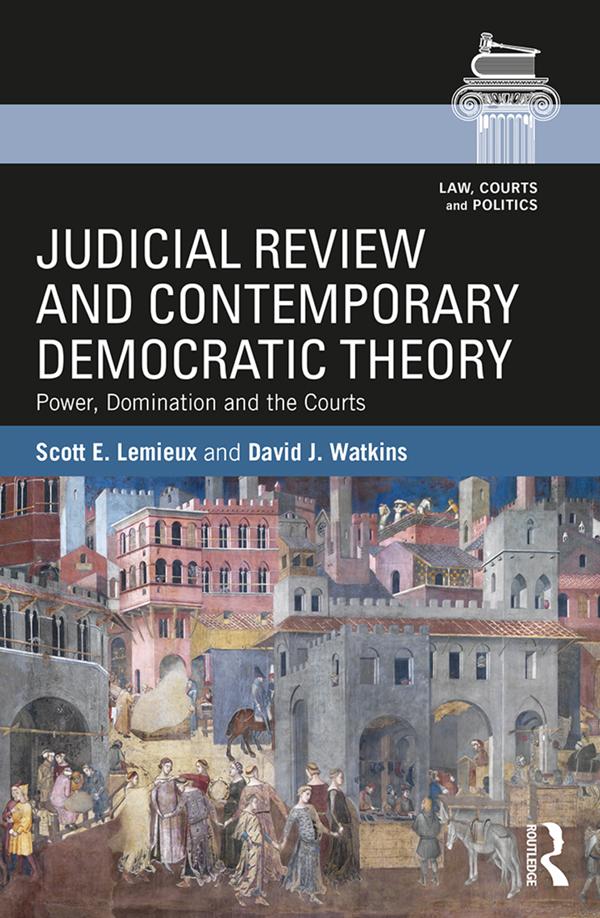
For decades, the question of judicial review’s status in a democratic political system has been adjudicated through the framework of what Alexander Bickel labeled "the counter-majoritarian difficulty." That is, the idea that judicial review is particularly problematic for democracy because it opposes the will of the majority.
Judicial Review and Contemporary Democratic Theory begins with an assessment of the empirical and theoretical flaws of this framework, and an account of the ways in which this framework has hindered meaningful investigation into judicial review’s value within a democratic political system. To replace the counter-majoritarian difficulty framework, Scott E. Lemieux and David J. Watkins draw on recent work in democratic theory emphasizing democracy’s opposition to domination and analyses of constitutional court cases in the United States, Canada, and elsewhere to examine judicial review in its institutional and political context.
Developing democratic criteria for veto points in a democratic system and comparing them to each other against these criteria, Lemieux and Watkins yield fresh insights into judicial review’s democratic value. This book is essential reading for students of law and courts, judicial politics, legal theory and constitutional law.
Płać wygodnie kartą, Klarną, Apple Pay lub Google Pay. Nie jesteś zadowolony? Zawsze masz 14-dniową gwarancję zwrotu pieniędzy. Więcej przeczytasz w naszych warunkach. Masz pytania? Napisz do nas na hello@memmo.org.
Memmo ułatwia naukę – gdziekolwiek jesteś na świecie. U nas znajdziesz podręczniki i sprytne narzędzia do nauki w jednym miejscu: streszczenia, quizy, podcasty i fiszki. A do tego Ted, Twój kumpel do nauki, który odpowie na wszystko, co Cię nurtuje. Ponad 50 000 studentów już tu się uczy – stworzone, byś uczył się szybciej i mniej stresował.