
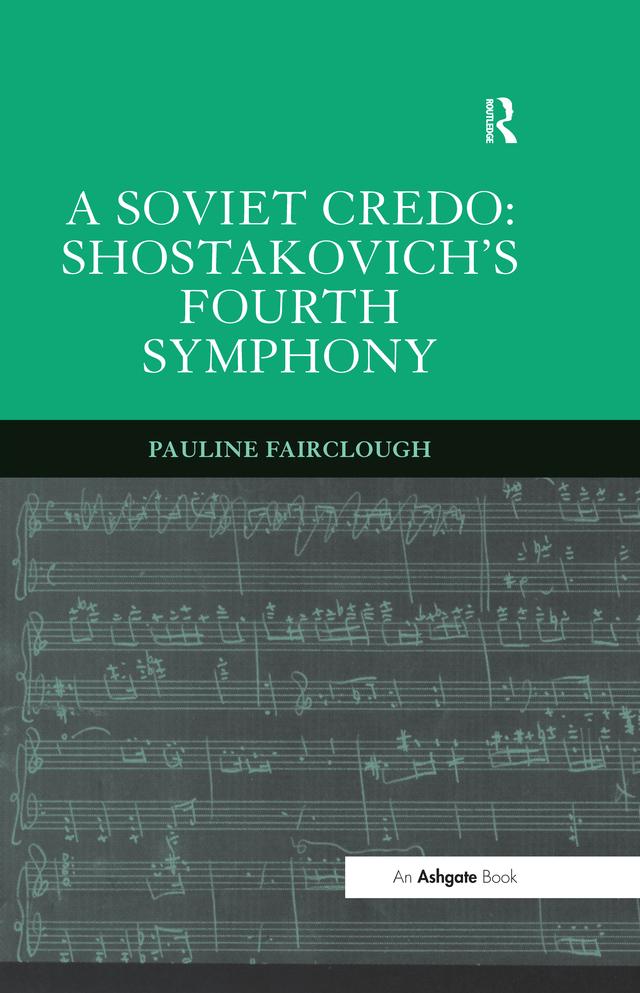
Composed in 1935-36 and intended to be his artistic 'credo', Shostakovich's Fourth Symphony was not performed publicly until 1961. Here, Dr Pauline Fairclough tackles head-on one of the most significant and least understood of Shostakovich's major works. She argues that the Fourth Symphony was radically different from its Soviet contemporaries in terms of its structure, dramaturgy, tone and even language, and therefore challenged the norms of Soviet symphonism at a crucial stage of its development. With the backing of prominent musicologists such as Ivan Sollertinsky, the composer could realistically have expected the premiere to have taken place, and may even have intended the symphony to be a model for a new kind of 'democratic' Soviet symphonism. Fairclough meticulously examines the score to inform a discussion of tonal and thematic processes, allusion, paraphrase and reference to musical types, or intonations. Such analysis is set deeply in the context of Soviet musical culture during the period 1932-36, involving Shostakovich's contemporaries Shebalin, Myaskovsky, Kabalevsky and Popov. A new method of analysis is also advanced here, where a range of Soviet and Western analytical methods are informed by the theoretical work of Shostakovich's contemporaries Viktor Shklovsky, Boris Tomashevsky, Mikhail Bakhtin and Ivan Sollertinsky, together with Theodor Adorno's late study of Mahler. In this way, the book will significantly increase an understanding of the symphony and its context.
Płać wygodnie kartą, Klarną, Apple Pay lub Google Pay. Nie jesteś zadowolony? Zawsze masz 14-dniową gwarancję zwrotu pieniędzy. Więcej przeczytasz w naszych warunkach. Masz pytania? Napisz do nas na hello@memmo.org.
Memmo ułatwia naukę – gdziekolwiek jesteś na świecie. U nas znajdziesz podręczniki i sprytne narzędzia do nauki w jednym miejscu: streszczenia, quizy, podcasty i fiszki. A do tego Ted, Twój kumpel do nauki, który odpowie na wszystko, co Cię nurtuje. Ponad 50 000 studentów już tu się uczy – stworzone, byś uczył się szybciej i mniej stresował.
Może Ci się spodobać
Kup książkę0