
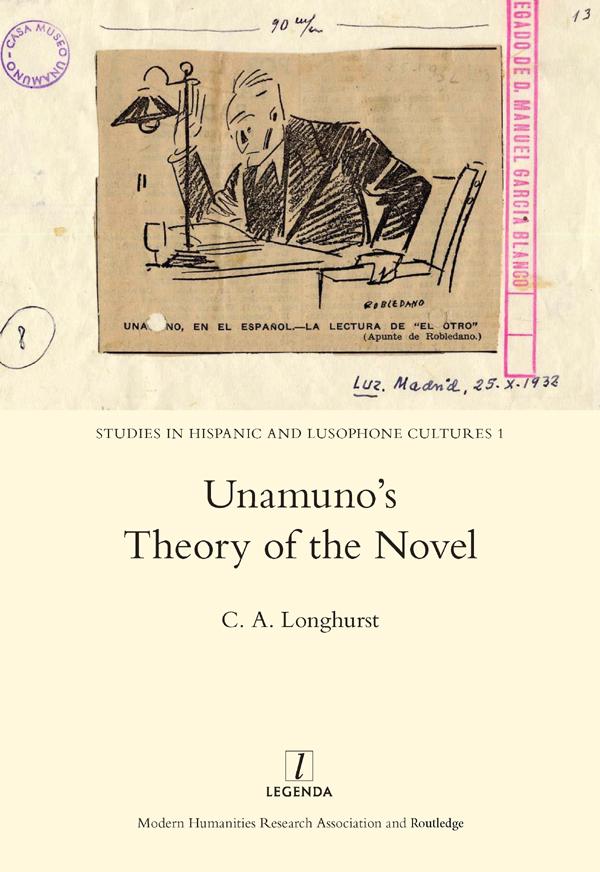
Miguel de Unamuno (1864-1936) is widely regarded as Spain's greatest and most controversial writer of the first half of the twentieth century. Professor of Greek, and later Rector, at the University of Salamanca, and a figure with a noted public profile in his day, he wrote a large number of philosophical, political and philological essays, as well as poems, plays and short stories, but it is his highly idiosyncratic novels, for which he coined the word nivola, that have attracted the greatest critical attention. Niebla (Mist, 1914) has become one of the most studied works of Spanish literature, such is the enduring fascination which it has provoked. In this study, C. A. Longhurst, a distinguished Unamuno scholar, sets out to show that behind Unamuno's fictional experiments there lies a coherent and quasi-philosophical concept of the novelesque genre and indeed of writing itself. Ideas about freedom, identity, finality, mutuality and community are closely intertwined with ideas on writing and reading and give rise to a new and highly personal way of conceiving fiction.
Strony: 227
Kategoria: Litteraturvetenskap & Teori
e-ISBN: 9781351538206
Waga przesyłki: 1.2 kg
Wysyłka w ciągu: 1-2 dni
Płać wygodnie kartą, Klarną, Apple Pay lub Google Pay. Nie jesteś zadowolony? Zawsze masz 14-dniową gwarancję zwrotu pieniędzy. Więcej przeczytasz w naszych warunkach. Masz pytania? Napisz do nas na hello@memmo.org.
Memmo ułatwia naukę – gdziekolwiek jesteś na świecie. U nas znajdziesz podręczniki i sprytne narzędzia do nauki w jednym miejscu: streszczenia, quizy, podcasty i fiszki. A do tego Ted, Twój kumpel do nauki, który odpowie na wszystko, co Cię nurtuje. Ponad 50 000 studentów już tu się uczy – stworzone, byś uczył się szybciej i mniej stresował.
Może Ci się spodobać
Kup książkę0