
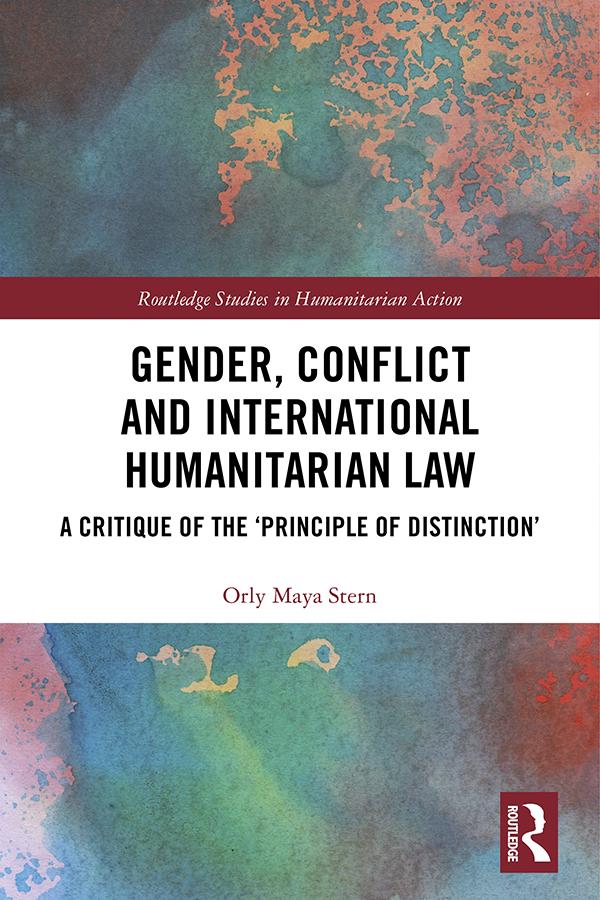
This book conducts a gendered critique of the ‘principle of distinction’ in international humanitarian law (IHL), with a focus on recent conflicts in Africa.
The ‘principle of distinction’ is core to IHL, and regulates who can and cannot be targeted in armed conflict. It states that civilians may not be targeted in attack, while combatants and those civilians directly participating in hostilities can be. The law defines what it means to be a combatant and a civilian, and sets out what behaviour constitutes direct participation. Close examination of the origins of the principle reveals that IHL was based on a gendered view of conflict, which envisages men as fighters and women as victims of war. Problematically, this view often does not accord with the reality in ‘new wars’ today in which women are playing increasingly active roles, often forming the backbone of fighting groups, and performing functions on which armed groups are highly reliant. Using women’s participation in ‘new wars’ in Africa as a study, this volume critically examines the principle through a gendered lens, questioning the extent to which the principle serves to protect women in modern conflicts and how it fails them. By doing so, it questions whether the principle of distinction is suitable to effectively regulate the conduct of hostilities in new wars.
This book will be of much interest to students of international law, gender studies, African politics, war and conflict studies, and international relations.
Płać wygodnie kartą, Klarną, Apple Pay lub Google Pay. Nie jesteś zadowolony? Zawsze masz 14-dniową gwarancję zwrotu pieniędzy. Więcej przeczytasz w naszych warunkach. Masz pytania? Napisz do nas na hello@memmo.org.
Memmo ułatwia naukę – gdziekolwiek jesteś na świecie. U nas znajdziesz podręczniki i sprytne narzędzia do nauki w jednym miejscu: streszczenia, quizy, podcasty i fiszki. A do tego Ted, Twój kumpel do nauki, który odpowie na wszystko, co Cię nurtuje. Ponad 50 000 studentów już tu się uczy – stworzone, byś uczył się szybciej i mniej stresował.