
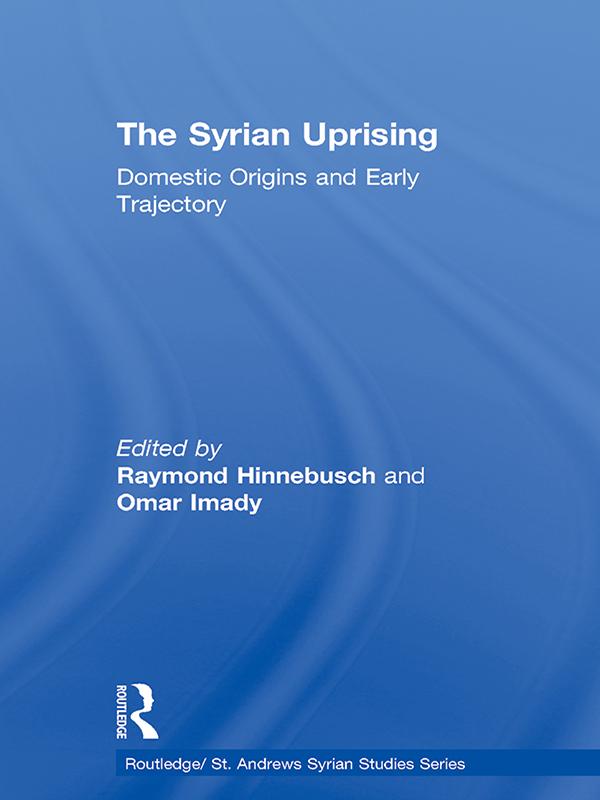
Most observers did not expect the Arab spring to spread to Syria, for a number of seemingly good reasons. Yet, with amazing rapidity, massive and unprecedented anti-regime mobilization took place, which put the regime very much on the defensive; what began as the Syrian Uprising in March 2011 has evolved into one of the world’s most damaging and protracted conflicts. Despite over six years having passed since the inception of the Syrian Uprising, this phenomenon remains difficult to fully grasp, both in terms of underlying forces and long-term implications.
This book presents a snapshot of how the Uprising developed in roughly the first two to three years (2011–2013) and addresses key questions regarding the domestic origins of the Uprising and its early trajectory. Firstly, what were the causes of the conflict, both in terms of structure (contradictions and crisis within the pre-Uprising order) and agency (choices of the actors)? Why did the Uprising not lead to democratization and instead descend into violent civil war with a sectarian dimension? With all 19 chapters addressing an aspect of the Uprising, the book focuses on internal dynamics, whilst a subsequent volume will look at the international dimension of the Uprising.
Taking an innovative and interdisciplinary approach that seeks to capture the full complexity of the phenomenon, this book contributes significantly to our understanding of the Syrian conflict, and will therefore be a valuable resource for anyone studying Middle Eastern Politics.
Płać wygodnie kartą, Klarną, Apple Pay lub Google Pay. Nie jesteś zadowolony? Zawsze masz 14-dniową gwarancję zwrotu pieniędzy. Więcej przeczytasz w naszych warunkach. Masz pytania? Napisz do nas na hello@memmo.org.
Memmo ułatwia naukę – gdziekolwiek jesteś na świecie. U nas znajdziesz podręczniki i sprytne narzędzia do nauki w jednym miejscu: streszczenia, quizy, podcasty i fiszki. A do tego Ted, Twój kumpel do nauki, który odpowie na wszystko, co Cię nurtuje. Ponad 50 000 studentów już tu się uczy – stworzone, byś uczył się szybciej i mniej stresował.