
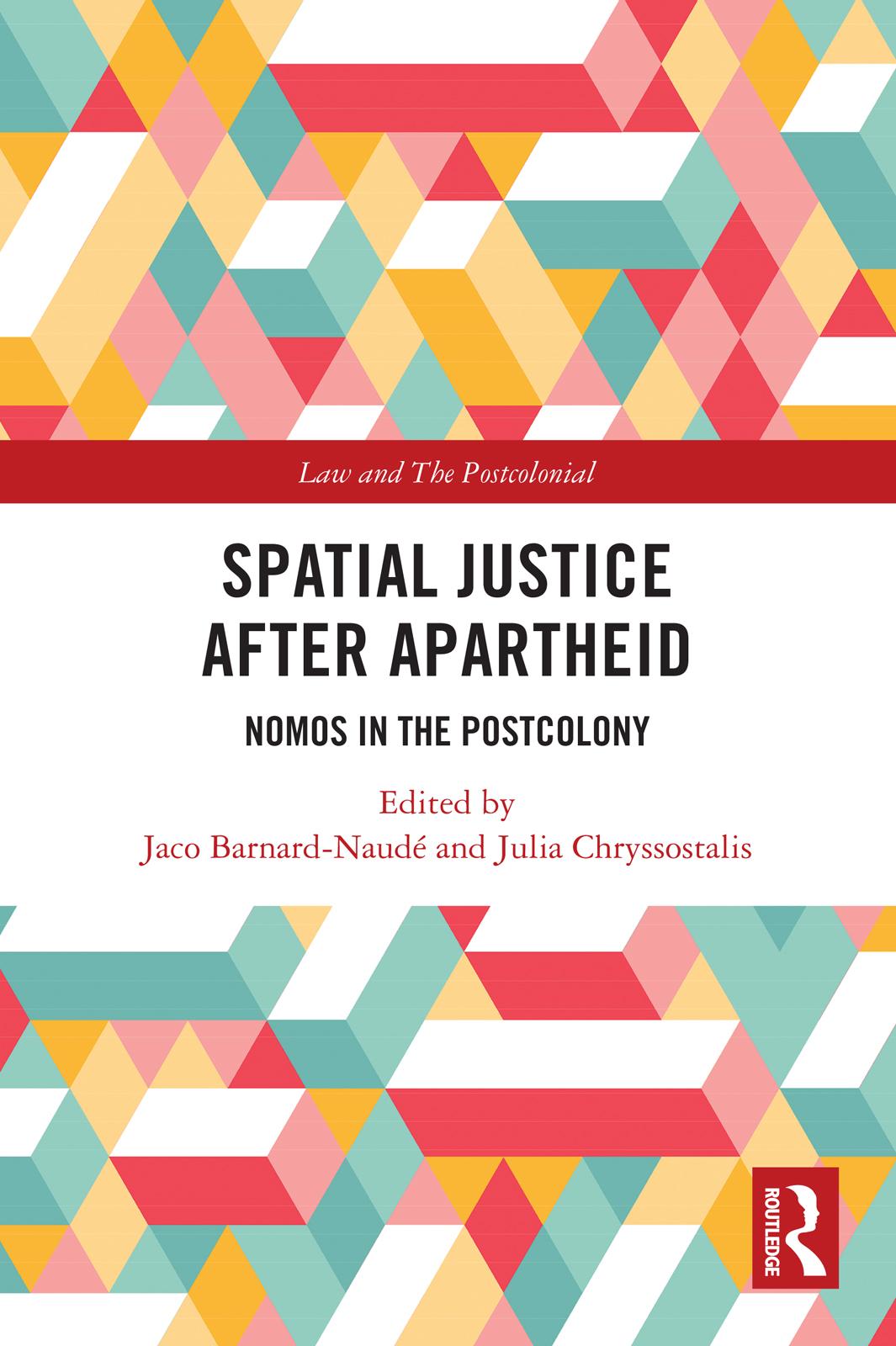
This book considers the question of spatial justice after apartheid from several disciplinary perspectives – jurisprudence, law, literature, architecture, photography and psychoanalysis are just some of the disciplines engaged here. However, the main theoretical device on which the authors comment is the legacy of what in Carl Schmitt’s terms is nomos as the spatialised normativity of sociality. Each author considers within the practical and theoretical constraints of their topic, the question of what nomos in its modern configuration may or may not contribute to a thinking of spatial justice after apartheid.
On the whole, the collection forces a confrontation between law’s spatiality in a “postcolonial” era, on the one hand, and the traumatic legacy of what Paul Gilroy has called the “colonial nomos”, on the other hand. In the course of this confrontation, critical questions of continuation, extension, disruption and rewriting are raised and confronted in novel and innovative ways that both challenge Schmitt’s account of nomos and affirm the centrality of the constitutive relation between law and space. The book promises to resituate the trajectory of nomos, while considering critical instances through which the spatial legacy of apartheid might at last be overcome.
This interdisciplinary book will appeal to scholars of critical legal theory, political philosophy, aesthetics and architecture.
Płać wygodnie kartą, Klarną, Apple Pay lub Google Pay. Nie jesteś zadowolony? Zawsze masz 14-dniową gwarancję zwrotu pieniędzy. Więcej przeczytasz w naszych warunkach. Masz pytania? Napisz do nas na hello@memmo.org.
Memmo ułatwia naukę – gdziekolwiek jesteś na świecie. U nas znajdziesz podręczniki i sprytne narzędzia do nauki w jednym miejscu: streszczenia, quizy, podcasty i fiszki. A do tego Ted, Twój kumpel do nauki, który odpowie na wszystko, co Cię nurtuje. Ponad 50 000 studentów już tu się uczy – stworzone, byś uczył się szybciej i mniej stresował.