
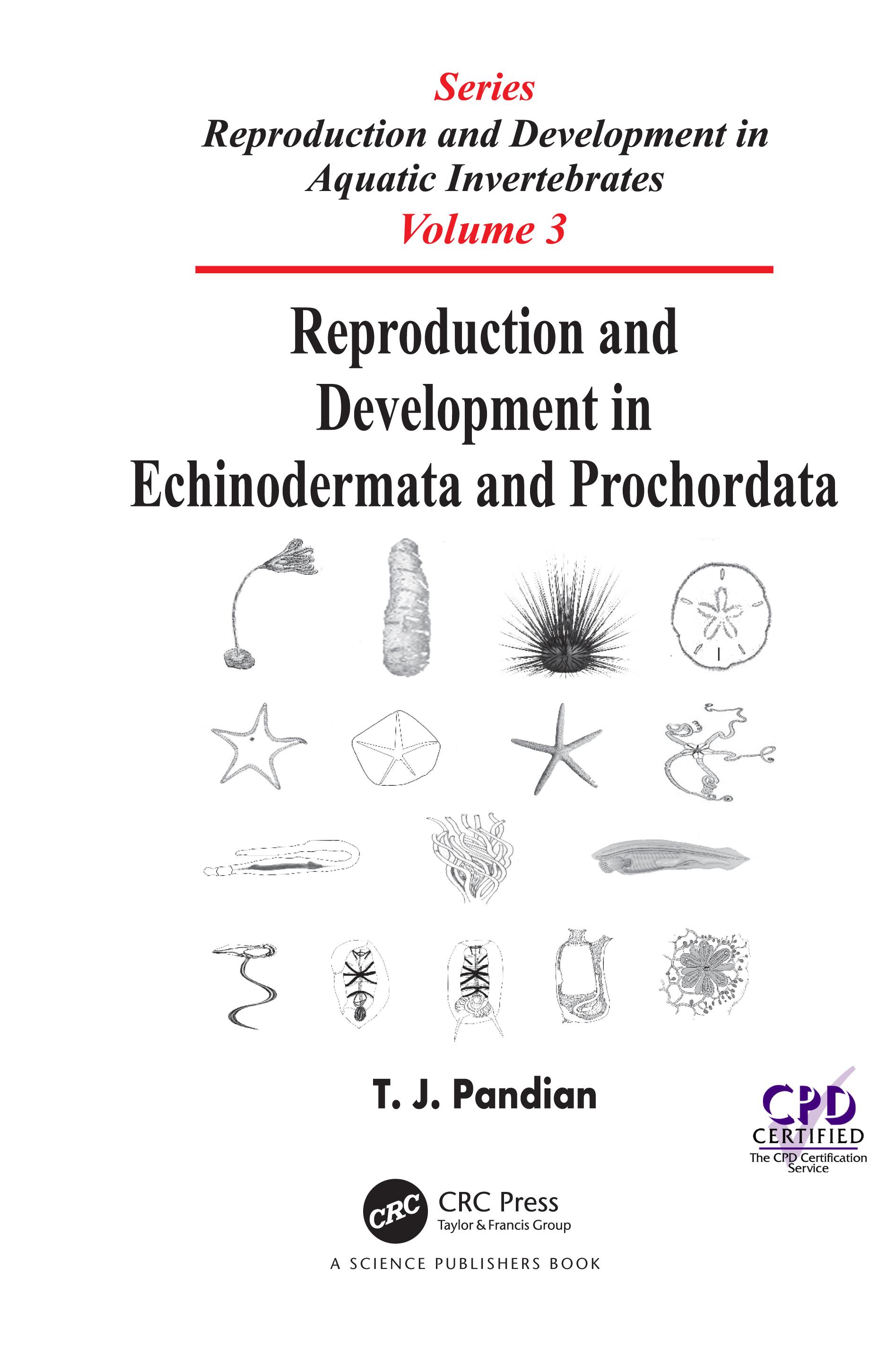
Echinoderms and prochordates occupy a key position in vertebrate evolution. The genomes of sea urchin share 70% homology with humans. Researches on cell cycle in sea urchin and phagocytosis in asteroids have fetched Nobel Prizes. In this context, this book assumes immense importance. Echinoderms are unique, as their symmetry is bilateral in larvae but pentamerous radial in adults. The latter has eliminated the development of an anterior head and bilateral appendages. Further, the obligate need to face the substratum for locomotion and acquisition of food has eliminated their planktonic and nektonic existence. Egg size, a decisive factor in recruitment, increases with decreasing depths up to 2,000-5,000 m in lecithotrophic asteroids and ophiuroids but remains constant in their planktotrophics. Smaller (< 18 mm) ophiuroids do not produce a lecithotrophic eggs but larger (> 110 mm) asteroids generate planktotrophic eggs only. Publications on sex ratio of echinoderms indicate the genetic determination of sex at fertilization but those on hybridization, karyotype and ploidy induction do not provide evidence for heterogametism. But the herbivorous echinoids and larvacea with their gonads harboring both germ cells and Nutritive Phagocytes (NPs) have economized the transportation and hormonal costs on gonadal function. Despite the amazing potential just 2 and 3% of echinoderms undergo clonal reproduction and regeneration, respectively. Fission is triggered, when adequate reserve nutrients are accumulated. It is the most prevalent mode of clonal reproduction in holothuroids, asteroids and ophiuroids. However, budding is a more prevalent mode of clonal reproduction in colonial hemichordates and urochordates. In echinoderms, fission and budding eliminate each other. Similarly, autoregulation of early development eliminates clonal reproduction in echinoids and solitary urochordates. In pterobranchs, thaliaceans and ascidians, the repeated and rapid budding leads to colonial formation. Coloniality imposes reductions in species number and body size, generation time and life span, gonad number and fecundity as well as switching from gonochorism to simultaneous hermaphorditism and oviparity to ovoviviparity/viviparity.
Płać wygodnie kartą, Klarną, Apple Pay lub Google Pay. Nie jesteś zadowolony? Zawsze masz 14-dniową gwarancję zwrotu pieniędzy. Więcej przeczytasz w naszych warunkach. Masz pytania? Napisz do nas na hello@memmo.org.
Memmo ułatwia naukę – gdziekolwiek jesteś na świecie. U nas znajdziesz podręczniki i sprytne narzędzia do nauki w jednym miejscu: streszczenia, quizy, podcasty i fiszki. A do tego Ted, Twój kumpel do nauki, który odpowie na wszystko, co Cię nurtuje. Ponad 50 000 studentów już tu się uczy – stworzone, byś uczył się szybciej i mniej stresował.