
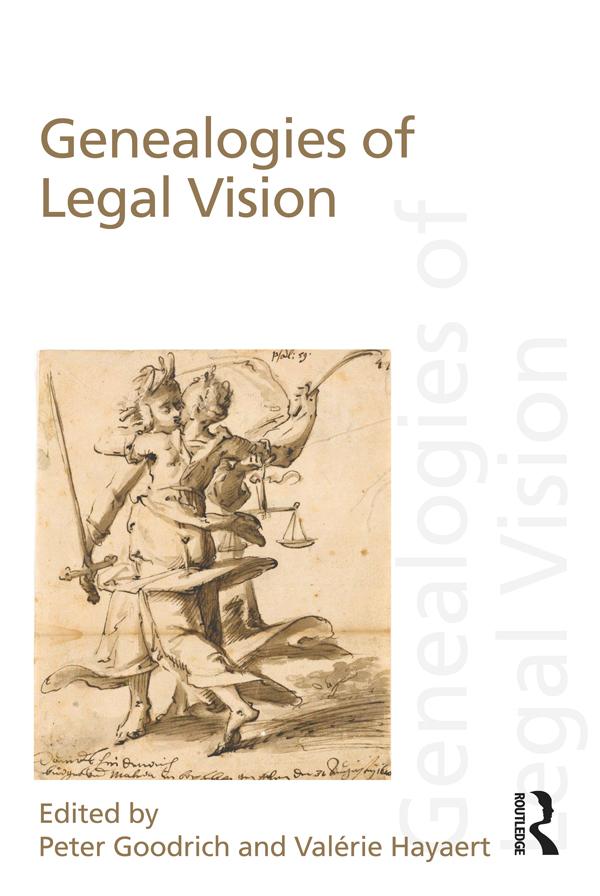
It was the classical task of legal rhetoric to make law both seen and understood. These conjoint goals came to be separated and opposed in modernity and a degree of blindness ensued. Legal reason was increasingly deemed to be a purely textual enterprise. Against this constraint and in furtherance of an incipient visual turn in legal studies, Genealogies of Legal Vision seeks to revive the classical ars iuris and to this end traces the history of regimes of visual control.
Law always relied in significant measure upon the use of visual representations, upon pictures, architecture, costume and statuary to convey authority and sovereign norm. Military, religious, administrative and legal insignia found juridical codification and expression in collections of signs of office, in heraldic codes, in genealogical devices, and then finally in the juridical invention in the mid-sixteenth century of the legal emblem book.
Genealogies of Legal Vision traces the complex lineage of the legal emblem and argues that the mens emblematica of the humanist lawyers was the inauguration of a visiocratic regime that continues into the multiple new technologies and novel media of contemporary governance. Bringing together leading experts on the history and art of legal emblems this collection provides a ground-breaking account of the long relationship between visibility, meaning and normativity.
Płać wygodnie kartą, Klarną, Apple Pay lub Google Pay. Nie jesteś zadowolony? Zawsze masz 14-dniową gwarancję zwrotu pieniędzy. Więcej przeczytasz w naszych warunkach. Masz pytania? Napisz do nas na hello@memmo.org.
Memmo ułatwia naukę – gdziekolwiek jesteś na świecie. U nas znajdziesz podręczniki i sprytne narzędzia do nauki w jednym miejscu: streszczenia, quizy, podcasty i fiszki. A do tego Ted, Twój kumpel do nauki, który odpowie na wszystko, co Cię nurtuje. Ponad 50 000 studentów już tu się uczy – stworzone, byś uczył się szybciej i mniej stresował.