
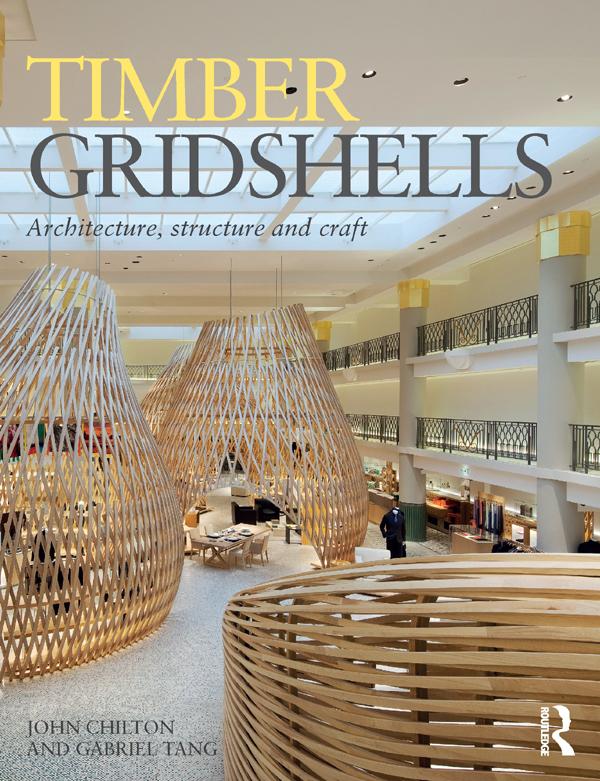
Throughout history, people have constructed simple timber lattice shelters such as the tepee or yurt, covered with animal skins, leaves, grasses and woven fabrics. Over the last fifty years, more sophisticated ‘webs of wood’ have emerged, with timber gridshells in particular becoming a structurally expressive form of architecture. Recent developments in digital design, 3-D modelling software, timber fabrication technologies as well as trends towards low-carbon construction have further reinforced architects’ interest in the use of lightweight timber grids and lattice structures.
This timely book charts the origin and evolution of the timber gridshell and its relation to timber lattice architecture. Drawing on a range of international case studies, the authors trace the effect advances in technology have had on design and construction in this field, providing a clear understanding of the structure, morphology, design process, and construction technology, and examining both the application and constraints of timber gridshells in architectural design.
Timber Gridshells is a highly illustrated, up-to-date resource which provides detailed answers and inspires new ideas. As such, it is essential reading for students of architecture as well as professional architects.
Płać wygodnie kartą, Klarną, Apple Pay lub Google Pay. Nie jesteś zadowolony? Zawsze masz 14-dniową gwarancję zwrotu pieniędzy. Więcej przeczytasz w naszych warunkach. Masz pytania? Napisz do nas na hello@memmo.org.
Memmo ułatwia naukę – gdziekolwiek jesteś na świecie. U nas znajdziesz podręczniki i sprytne narzędzia do nauki w jednym miejscu: streszczenia, quizy, podcasty i fiszki. A do tego Ted, Twój kumpel do nauki, który odpowie na wszystko, co Cię nurtuje. Ponad 50 000 studentów już tu się uczy – stworzone, byś uczył się szybciej i mniej stresował.