
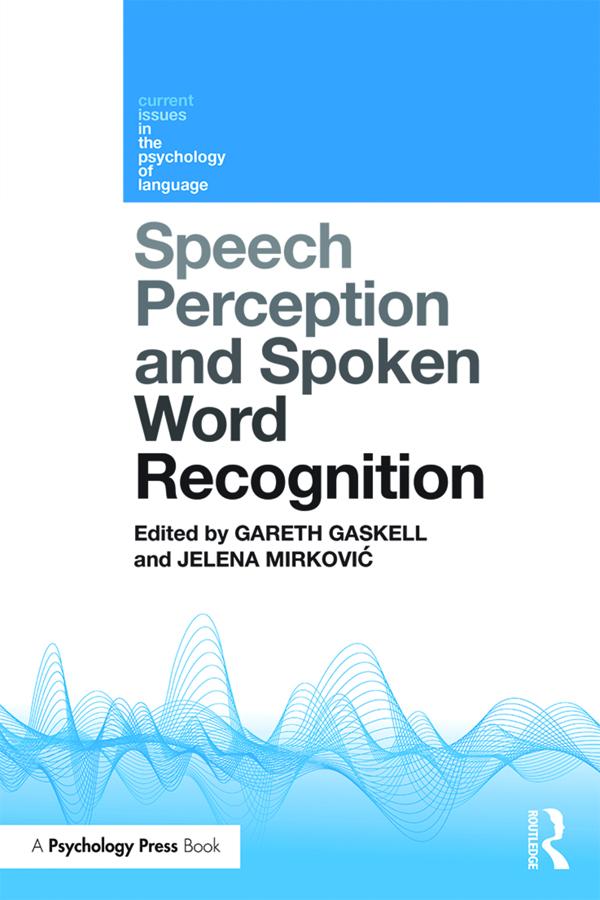
Speech Perception and Spoken Word Recognition features contributions from the field’s leading scientists, and covers recent developments and current issues in the study of cognitive and neural mechanisms that take patterns of air vibrations and turn them ‘magically’ into meaning. The volume makes a unique theoretical contribution in linking behavioural and cognitive neuroscience research, and cutting across traditional strands of study, such as adult and developmental processing.
The book:
- Focusses on the state of the art in the study of speech perception and spoken word recognition
- Discusses the interplay between behavioural and cognitive neuroscience evidence, and between adult and developmental research
- Evaluates key theories in the field and relates them to recent empirical advances, including the relationship between speech perception and speech production, meaning representation and real-time activation, and bilingual and monolingual spoken word recognition
- Examines emerging areas of study such as word learning and time-course of memory consolidation, and how the science of human speech perception can help computer speech recognition
Overall this book presents a renewed focus on theoretical and developmental issues, as well as a multifaceted and broad review of the state of research, in speech perception and spoken word recognition. Particularly interested readers will be researchers of psycholinguistics and adjoining fields as well as advanced undergraduate and postgraduate students.
Płać wygodnie kartą, Klarną, Apple Pay lub Google Pay. Nie jesteś zadowolony? Zawsze masz 14-dniową gwarancję zwrotu pieniędzy. Więcej przeczytasz w naszych warunkach. Masz pytania? Napisz do nas na hello@memmo.org.
Memmo ułatwia naukę – gdziekolwiek jesteś na świecie. U nas znajdziesz podręczniki i sprytne narzędzia do nauki w jednym miejscu: streszczenia, quizy, podcasty i fiszki. A do tego Ted, Twój kumpel do nauki, który odpowie na wszystko, co Cię nurtuje. Ponad 50 000 studentów już tu się uczy – stworzone, byś uczył się szybciej i mniej stresował.