
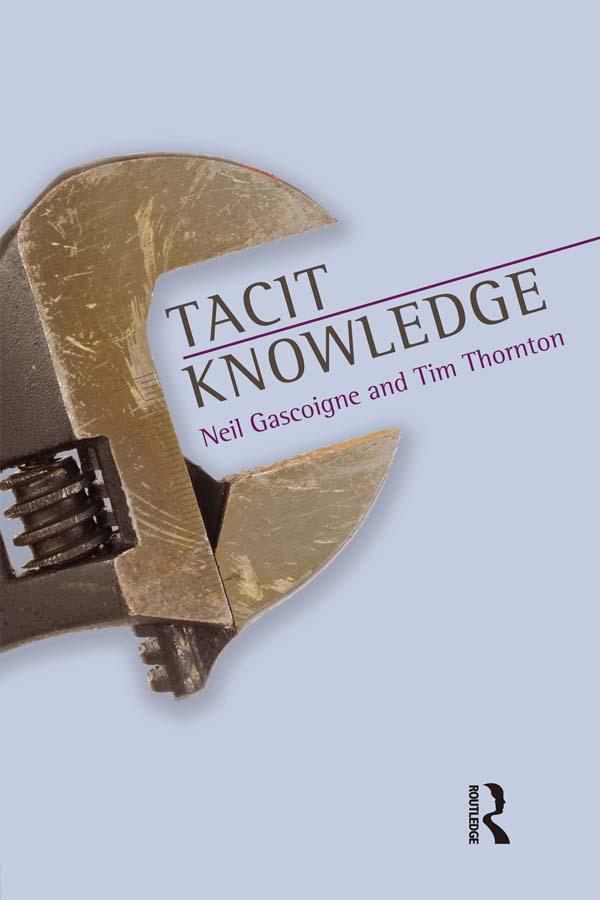
Tacit knowledge is the form of implicit knowledge that we rely on for learning. It is invoked in a wide range of intellectual inquiries, from traditional academic subjects to more pragmatically orientated investigations into the nature and transmission of skills and expertise. Notwithstanding its apparent pervasiveness, the notion of tacit knowledge is a complex and puzzling one. What is its status as knowledge? What is its relation to explicit knowledge? What does it mean to say that knowledge is tacit? Can it be measured? Recent years have seen a growing interest from philosophers in understanding the nature of tacit knowledge. Philosophers of science have discussed its role in scientific problem-solving; philosophers of language have been concerned with the speaker's relation to grammatical theories; and phenomenologists have attempted to describe the relation of explicit theoretical knowledge to a background understanding of matters that are taken for granted. This book seeks to bring a unity to these diverse philosophical discussions by clarifying their conceptual underpinnings. In addition the book advances a specific account of tacit knowledge that elucidates the importance of the concept for understanding the character of human cognition, and demonstrates the relevance of the recommended account to those concerned with the communication of expertise. The book will be of interest to philosophers of language, epistemologists, cognitive psychologists and students of theoretical linguistics.
Płać wygodnie kartą, Klarną, Apple Pay lub Google Pay. Nie jesteś zadowolony? Zawsze masz 14-dniową gwarancję zwrotu pieniędzy. Więcej przeczytasz w naszych warunkach. Masz pytania? Napisz do nas na hello@memmo.org.
Memmo ułatwia naukę – gdziekolwiek jesteś na świecie. U nas znajdziesz podręczniki i sprytne narzędzia do nauki w jednym miejscu: streszczenia, quizy, podcasty i fiszki. A do tego Ted, Twój kumpel do nauki, który odpowie na wszystko, co Cię nurtuje. Ponad 50 000 studentów już tu się uczy – stworzone, byś uczył się szybciej i mniej stresował.
Może Ci się spodobać
Kup książkę0