
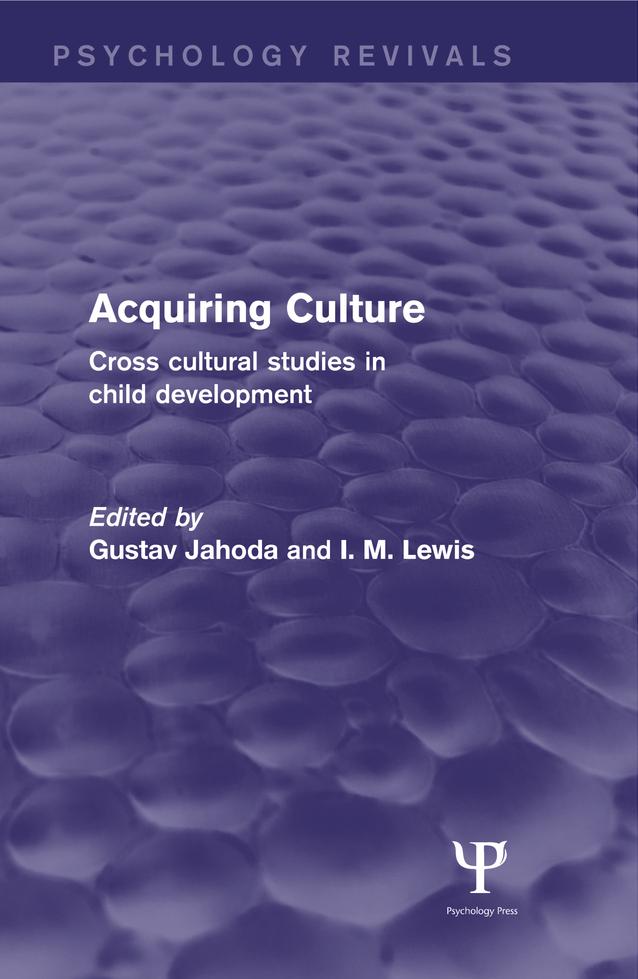
Until the 70s and 80s anthropologists studying different cultures had mainly confined themselves to the behaviour and idea systems of adults. Psychologists, on the other hand, working mainly in Europe and America, had studied child development in their own settings and simply assumed the universality of their findings. Thus both disciplines had largely ignored a crucial problem area: the way in which children from birth onwards learn to become competent members of their culture. This process, which has been called ‘the quintessential human adaptation’, constitutes the theme of this volume, originally published in 1988.
It derives from a workshop held at the London School of Economics which brought together fieldworkers who in their studies had paid more than usual attention to children in their cultures. Their experience and foci of interest were varied but this very diversity serves to illuminate different facets of the acquisition of culture by children, ranging in age from pre-verbal infants to adolescents.
Evolutionarily primed for culture-learning, children are responsive to a rich web of influences from subtle and indirect as in their music and dance to direct teaching in the family guided by culture-specific ideas about child psychology. Some of the salient things they learn relate to gender, status and power, critical for the functioning of all societies.
The introductory essay provides the necessary historical background of the development of child study in both anthropology and psychology and outlined how future research in the ethnography of childhood should proceed. The book concludes with an annotated bibliography providing a guide to the literature from 1970 onwards.
Płać wygodnie kartą, Klarną, Apple Pay lub Google Pay. Nie jesteś zadowolony? Zawsze masz 14-dniową gwarancję zwrotu pieniędzy. Więcej przeczytasz w naszych warunkach. Masz pytania? Napisz do nas na hello@memmo.org.
Memmo ułatwia naukę – gdziekolwiek jesteś na świecie. U nas znajdziesz podręczniki i sprytne narzędzia do nauki w jednym miejscu: streszczenia, quizy, podcasty i fiszki. A do tego Ted, Twój kumpel do nauki, który odpowie na wszystko, co Cię nurtuje. Ponad 50 000 studentów już tu się uczy – stworzone, byś uczył się szybciej i mniej stresował.