
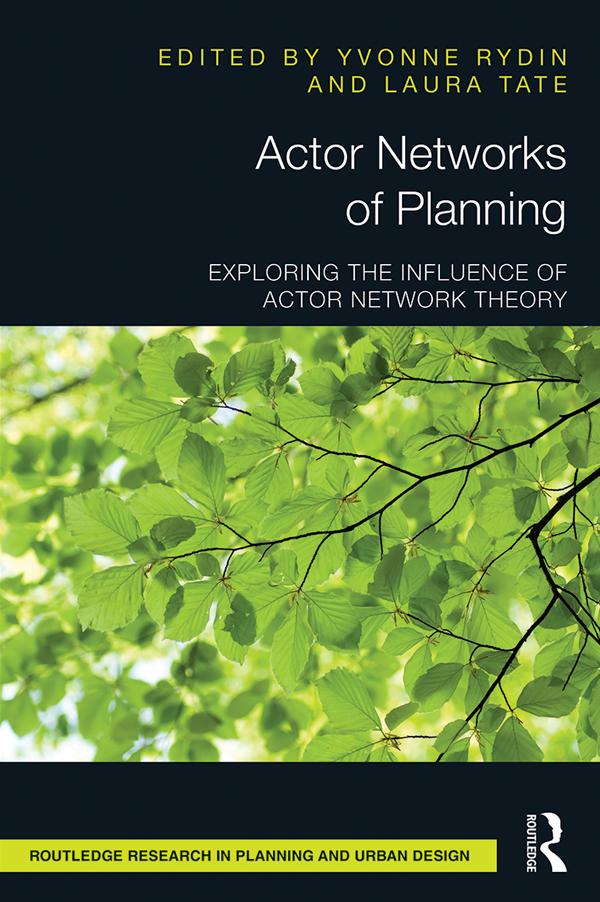
Planning is centrally focused on places which are significant to people, including both the built and natural environments. In making changes to these places, planning outcomes inevitably benefit some and disadvantage others. It is perhaps surprising that Actor Network Theory (ANT) has only recently been considered as an appropriate lens through which to understand planning practice. This book brings together an international range of contributors to explore such potential of ANT in more detail.
While it can be thought of as a subset of complexity theory, given its appreciation for non-linear processes and responses, ANT has its roots in the sociology of scientific and technology studies. ANT now comprises a rich set of concepts that can be applied in research, theoretical and empirical. It is a relational approach that posits a radical symmetry between social and material actors (or actants). It suggests the importance of dynamic processes by which networks of relationships become formed, shift and have effect.
And while not inherently normative, ANT has the potential to strengthen other more normative domains of planning theory through its unique analytical lens. However, this requires theoretical and empirical work and the papers in this volume undertake such work. This is the first volume to provide a full consideration of how ANT can contribute to planning studies, and suggests a research agenda for conceptual development and empirical application of the theory.
Płać wygodnie kartą, Klarną, Apple Pay lub Google Pay. Nie jesteś zadowolony? Zawsze masz 14-dniową gwarancję zwrotu pieniędzy. Więcej przeczytasz w naszych warunkach. Masz pytania? Napisz do nas na hello@memmo.org.
Memmo ułatwia naukę – gdziekolwiek jesteś na świecie. U nas znajdziesz podręczniki i sprytne narzędzia do nauki w jednym miejscu: streszczenia, quizy, podcasty i fiszki. A do tego Ted, Twój kumpel do nauki, który odpowie na wszystko, co Cię nurtuje. Ponad 50 000 studentów już tu się uczy – stworzone, byś uczył się szybciej i mniej stresował.