
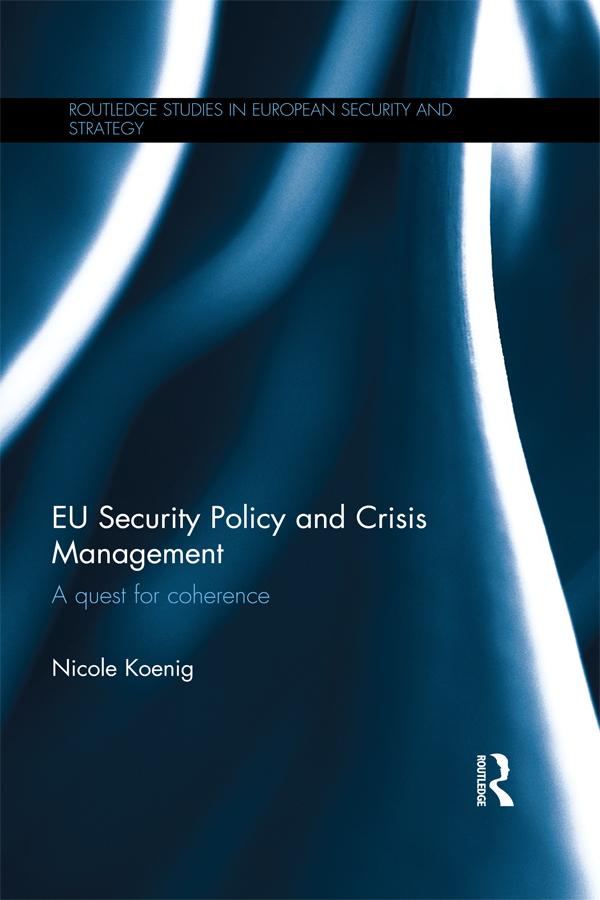
This book explores European Union crisis management and draws implications for its role as an international security actor.
The success of EU crisis management has varied greatly and this book aims to identify the key factors that explain the differing degrees of coherence through a comparative analysis of its multidimensional crisis responses in Africa. The empirical focus lies on three prominent EU crisis management cases, namely Libya in 2011, Somalia in 2011-2012, and the Sahel in 2012-2013. It analyses the activities and interaction of EU institutional actors and member states, with a focus on France, the United Kingdom, and Germany. The book argues that the EU represents a rather unpredictable security actor, whose multi-level coherence is contingent on the congruence of domestic economic and electoral interests, as well as national threat perceptions, and the extent to which EU-level coherence norms resonate with national norms on the use of force and modes of multilateral cooperation. In sum, this book offers systematic insight into EU crisis management and clarifies the conceptual and empirical boundaries of the comprehensive approach. Finally, the study of the micro-foundations of coherence allows for policy-relevant suggestions on the EU’s future role as a security actor.
This book will be of much interest to students of EU policy, European Security, Peace and Conflict Studies, African Politics and IR in general.
Płać wygodnie kartą, Klarną, Apple Pay lub Google Pay. Nie jesteś zadowolony? Zawsze masz 14-dniową gwarancję zwrotu pieniędzy. Więcej przeczytasz w naszych warunkach. Masz pytania? Napisz do nas na hello@memmo.org.
Memmo ułatwia naukę – gdziekolwiek jesteś na świecie. U nas znajdziesz podręczniki i sprytne narzędzia do nauki w jednym miejscu: streszczenia, quizy, podcasty i fiszki. A do tego Ted, Twój kumpel do nauki, który odpowie na wszystko, co Cię nurtuje. Ponad 50 000 studentów już tu się uczy – stworzone, byś uczył się szybciej i mniej stresował.