
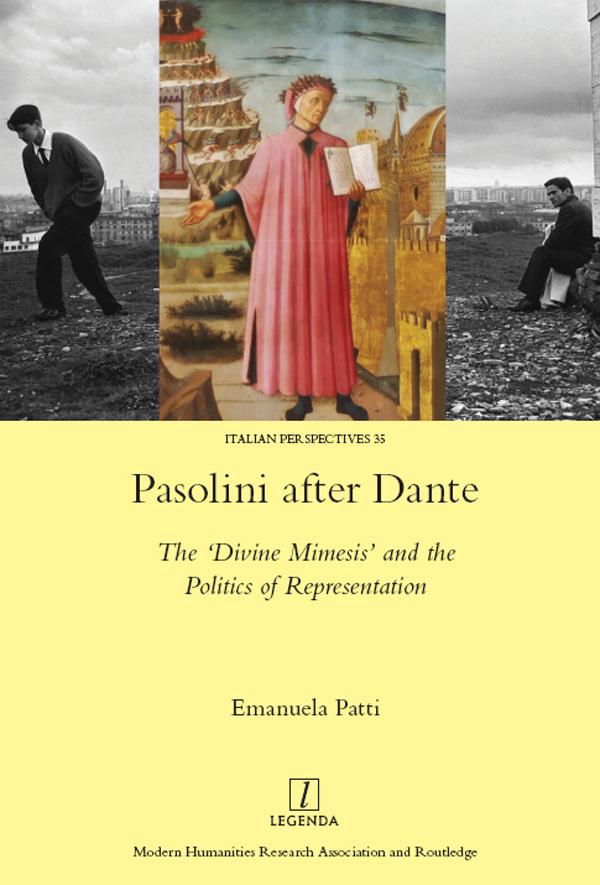
What role did Dante play in the work of Pier Paolo Pasolini (1922-1975)? His unfinished and fragmented imitation of the Comedia, La Divina Mimesis, is only one outward sign of what was a sustained dialogue with Dante on representation begun in the early 1950s. During this period, the philologists Gianfranco Contini (1912-1990) and Erich Auerbach (1892-1957) played a crucial role in Pasolini’s re-thinking of ‘represented reality’, suggesting Dante as the best literary, authorial and political model for a generation of postwar Italian writers. This emerged first as ‘Dantean realism’ in Pasolini’s prose and poetry, after Contini’s interpretation of Dante and of his plurilingualism, and then as ‘figural realism’ in his cinema, after Auerbach’s concepts of Dante’s figura and ‘mingling of styles’. Following the evolution of Pasolini’s mimetic ideal from these formative influences through to La Divina Mimesis, Emanuela Patti explores Pasolini’s politics of representation in relation to the ‘national-popular’, the ‘questione della lingua’ and the Italian post-war debates on neorealism, while also providing a new interpretation of some of his major literary and cinematic works.
Płać wygodnie kartą, Klarną, Apple Pay lub Google Pay. Nie jesteś zadowolony? Zawsze masz 14-dniową gwarancję zwrotu pieniędzy. Więcej przeczytasz w naszych warunkach. Masz pytania? Napisz do nas na hello@memmo.org.
Memmo ułatwia naukę – gdziekolwiek jesteś na świecie. U nas znajdziesz podręczniki i sprytne narzędzia do nauki w jednym miejscu: streszczenia, quizy, podcasty i fiszki. A do tego Ted, Twój kumpel do nauki, który odpowie na wszystko, co Cię nurtuje. Ponad 50 000 studentów już tu się uczy – stworzone, byś uczył się szybciej i mniej stresował.