
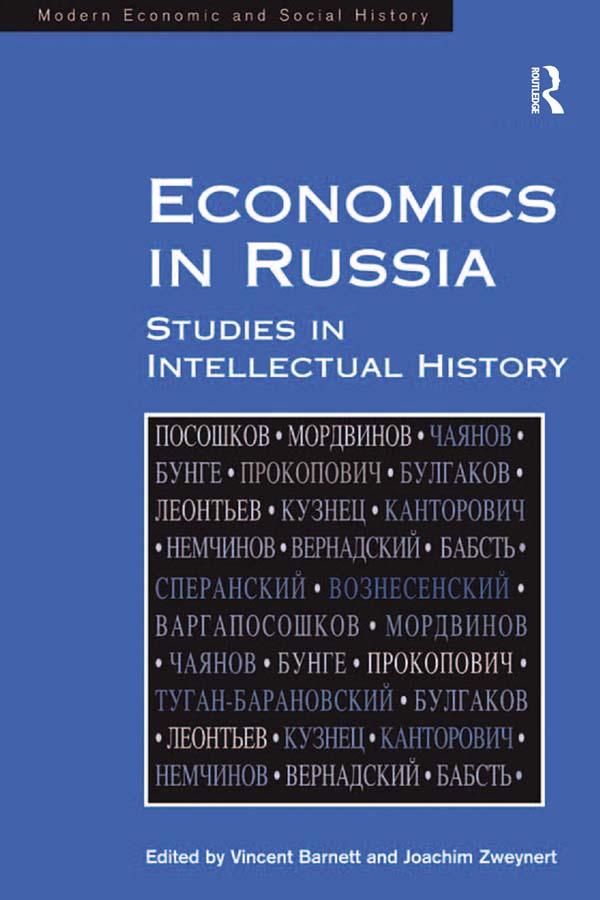
The history of Russian economic ideas from the sixteenth century to contemporary times is a fascinating, tumultuous yet neglected topic among Western scholars. Whilst over the last 15 years increasing amounts of work has been done on the subject, co-operation between Russian and Western researchers in this field leaves much to be desired. In order to improve this situation, this volume unites Russian and non-Russian researchers together to provide an overview of the current state of the topic and to give a stimulus for further research. Bringing together scholars from the UK, Germany, Japan, Australia, Finland and Russia, the collection puts forward differing, yet complimentary, perspectives on the long-term history of Russian economic ideas. Offering a broad collection of articles covering the period from the seventeenth to the twentieth centuries, authors have approached the subject from diverse theoretical angles. Contributions in the tradition of Blaug and Schumpeter focusing on economic analysis in a narrower sense, and contributions that - in line with authors like Pribram or Perlman/McCann - deal with economic thought in the context of history and culture, are all represented. In terms of content, the editors have encouraged approaches that represent different economic traditions in order to encourage a diversity of opinions on the national development of Russian economics. As such the volume offers a broad and very relevant assessment of the subject for both historians and economists alike.
Płać wygodnie kartą, Klarną, Apple Pay lub Google Pay. Nie jesteś zadowolony? Zawsze masz 14-dniową gwarancję zwrotu pieniędzy. Więcej przeczytasz w naszych warunkach. Masz pytania? Napisz do nas na hello@memmo.org.
Memmo ułatwia naukę – gdziekolwiek jesteś na świecie. U nas znajdziesz podręczniki i sprytne narzędzia do nauki w jednym miejscu: streszczenia, quizy, podcasty i fiszki. A do tego Ted, Twój kumpel do nauki, który odpowie na wszystko, co Cię nurtuje. Ponad 50 000 studentów już tu się uczy – stworzone, byś uczył się szybciej i mniej stresował.
Może Ci się spodobać
Kup książkę0