
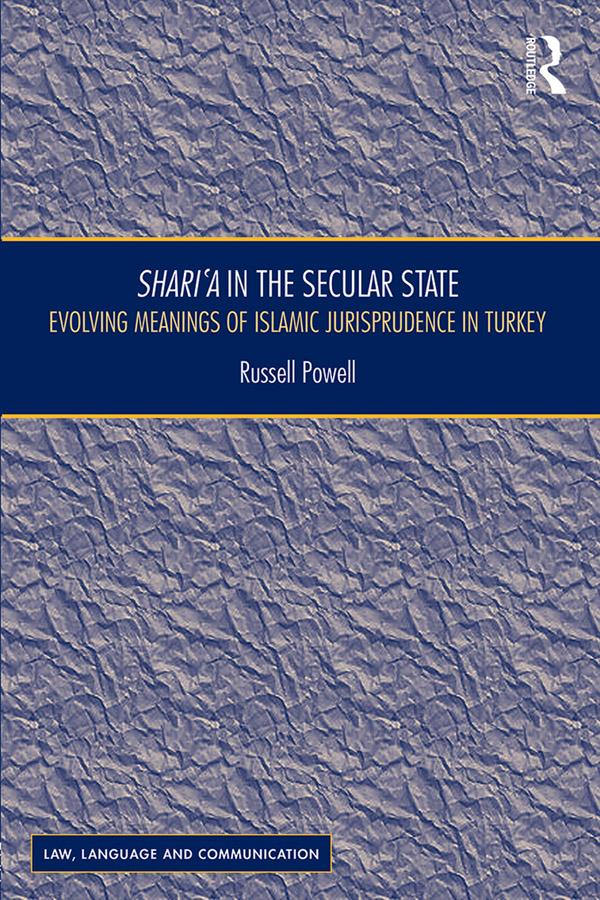
Words in both law and religion can shape power relationships and are often highly disputed. Shari`a lies within the overlap of these two spheres and provides a unique subject for the study of meaning in that liminal space. This book contributes important insights related to Islamic jurisprudence and secularism in the Turkish context and regarding the role of language in contested legal and religious contexts.
The study begins by providing a historical framework for the ideas and terms covered, including concepts of religion in general, Shari`a in particular, and secularism in the Turkish state. It goes on to examine empirical research to describe and analyze contemporary Turkish understandings of religion and Shari`a. The author’s research indicates that there is often a disconnect between supporting the adoption of Shari`a and supporting the regulation of everyday behavior through civil codes. Thus, “Shari`a” seems to have taken on new meanings as groups have sought either to appropriate or criticize it. It is a quintessential example of fractured and contextual meaning at the center of both religious and legal traditions.
This book is essential reading for both academics and those interested in law, linguistics, history, political science, anthropology, sociology, religious studies, or Near Eastern studies.
Płać wygodnie kartą, Klarną, Apple Pay lub Google Pay. Nie jesteś zadowolony? Zawsze masz 14-dniową gwarancję zwrotu pieniędzy. Więcej przeczytasz w naszych warunkach. Masz pytania? Napisz do nas na hello@memmo.org.
Memmo ułatwia naukę – gdziekolwiek jesteś na świecie. U nas znajdziesz podręczniki i sprytne narzędzia do nauki w jednym miejscu: streszczenia, quizy, podcasty i fiszki. A do tego Ted, Twój kumpel do nauki, który odpowie na wszystko, co Cię nurtuje. Ponad 50 000 studentów już tu się uczy – stworzone, byś uczył się szybciej i mniej stresował.