
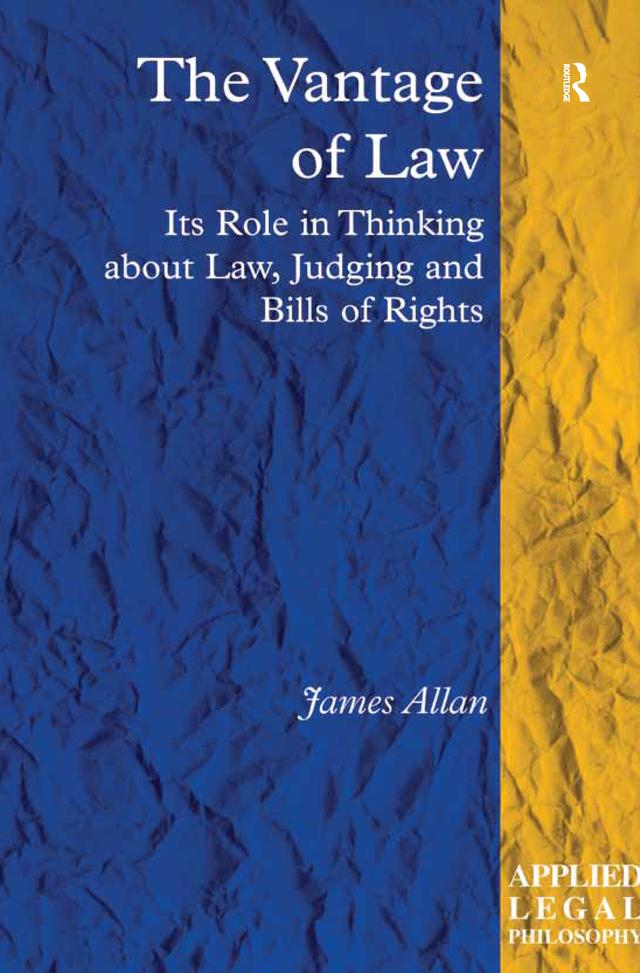
The premise of this book is that a shift of vantage will help elucidate various important issues of law related to judging, to bills of rights and to more abstract questions of legal philosophy. The work begins by focussing on the jurisprudential issue of whether it is desirable to keep separate the demands of law and of morality and uses the device of changing vantages to elucidate the many issues that fall under that aegis. This is followed by a consideration of how judges ought to do their job when interpreting and whether the rule of law ideal differs from rule by judges. The last part of the book focuses explicitly on bills of rights. Building on the earlier parts, the author uses his device of shifting vantages to provide insights into how these instruments affect democratic decision-making and from which perspectives they will look attractive and unattractive. Written in a clear, accessible and engaging style, the book demonstrates that vantage point is a key criterion affecting how one understands and evaluates, firstly, some of the theoretical debates in jurisprudence and then, secondly, what judges are doing and whether a bill of rights is desirable or not.
Płać wygodnie kartą, Klarną, Apple Pay lub Google Pay. Nie jesteś zadowolony? Zawsze masz 14-dniową gwarancję zwrotu pieniędzy. Więcej przeczytasz w naszych warunkach. Masz pytania? Napisz do nas na hello@memmo.org.
Memmo ułatwia naukę – gdziekolwiek jesteś na świecie. U nas znajdziesz podręczniki i sprytne narzędzia do nauki w jednym miejscu: streszczenia, quizy, podcasty i fiszki. A do tego Ted, Twój kumpel do nauki, który odpowie na wszystko, co Cię nurtuje. Ponad 50 000 studentów już tu się uczy – stworzone, byś uczył się szybciej i mniej stresował.
Może Ci się spodobać
Kup książkę0