
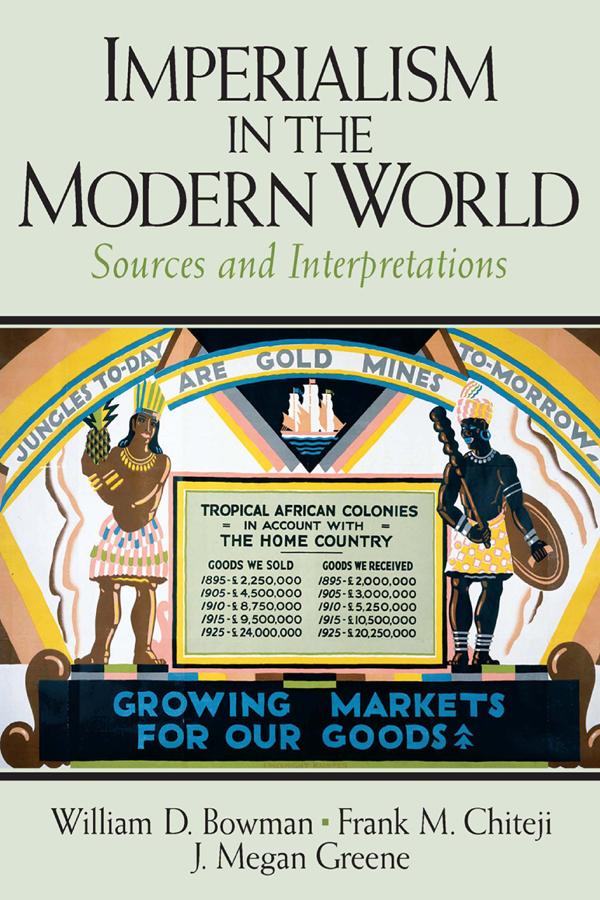
Imperialism in the Modern World combines narrative, primary and secondary sources, and visual documents to examine global relations in the nineteenth and twentieth centuries.
The three co-editors, Professors Bowman, Chiteji, and Greene, have taught for many years global history classes in a variety of institutions. They wrote Imperialism in the Modern World to solve the problem of allowing teachers to combine primary and secondary texts easily and systematically to follow major themes in global history (some readers use primary materials exclusively. Some focus on secondary arguments). This book is more focused than other readers on the markets for those teachers who are offering more specialized world history courses - one important trend in global history is away from simply trying to cover everything to teaching real connections in more chronologically and thematically focused courses. The reader also provides a genuine diversity of global perspectives and invites students to study seriously world history from a critical framework. Too many readers offer a smorgasbord approach to world history that leaves students dazed and confused. This reader avoids that approach and will therefore solve many problems that teachers have in constructing and teaching world history courses at the introductory or upper-division levels. The reader will allow show students how to read historical documents through a hands-on demonstration in the introduction. The book also incorporates images as visual documents. Finally, the book conceives of global history in the widest possible terms; it contains pieces on political, diplomatic, economic, and military history, to be sure, but it also has selections on technology, medicine, women, the environment, social changes, and cultural patterns. Other readers can not match this text's breadth because they are chronologically and thematically so extended.
Płać wygodnie kartą, Klarną, Apple Pay lub Google Pay. Nie jesteś zadowolony? Zawsze masz 14-dniową gwarancję zwrotu pieniędzy. Więcej przeczytasz w naszych warunkach. Masz pytania? Napisz do nas na hello@memmo.org.
Memmo ułatwia naukę – gdziekolwiek jesteś na świecie. U nas znajdziesz podręczniki i sprytne narzędzia do nauki w jednym miejscu: streszczenia, quizy, podcasty i fiszki. A do tego Ted, Twój kumpel do nauki, który odpowie na wszystko, co Cię nurtuje. Ponad 50 000 studentów już tu się uczy – stworzone, byś uczył się szybciej i mniej stresował.