
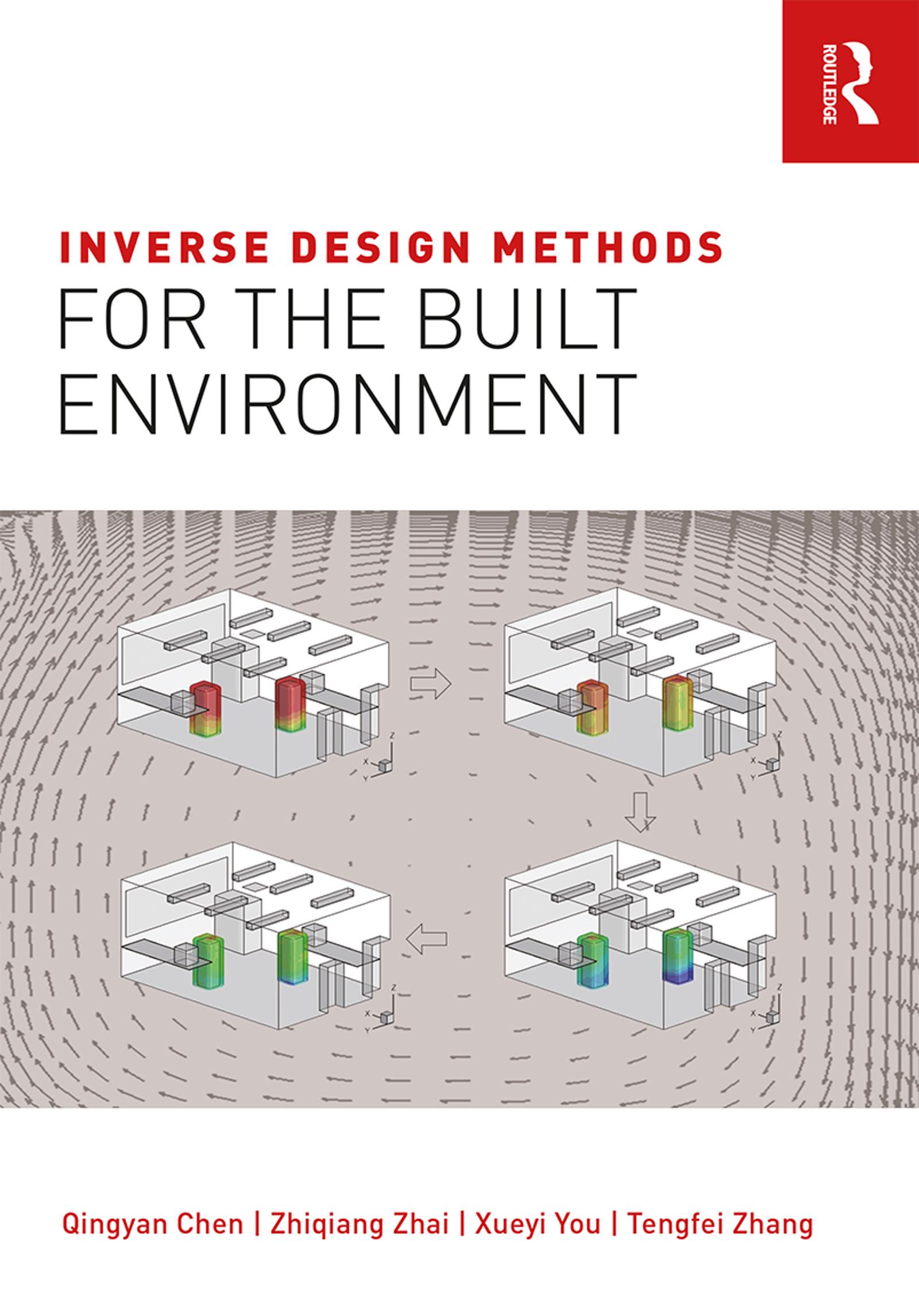
The inverse design approach is new to the built environment research and design community, though it has been used in other industries including automobile and airplane design. This book, from some of the pioneers of inverse design applications in the built environment, introduces the basic principles of inverse design and the specific techniques that can be applied to built environment systems. The authors' inverse design concept uses the desired enclosed environment as the design objective and inversely determines the systems required to achieve the objective.
The book discusses a number of backward and forward methods for inverse design. Backward methods, such as the quasi-reversibility method, the pseudo-reversibility method, and the regularized inverse matrix method, can be used to identify contaminant sources in an enclosed environment. However, these methods cannot be used to inversely design a desired indoor environment. Forward methods, such as the computational-fluid-dynamics (CFD)-based genetic algorithm (GA) method, the CFD-based adjoint method, the CFD-based artificial neural network (ANN) method, and the CFD-based proper orthogonal decomposition (POD) method, show the promise in the inverse design of airflow and heat transfer in an enclosed environment.
The book describes the fundamentals of the methods for beginners, provides exciting design examples for the reader to duplicate, discusses the pros and cons of each design method and points out the knowledge gaps for further development.
Płać wygodnie kartą, Klarną, Apple Pay lub Google Pay. Nie jesteś zadowolony? Zawsze masz 14-dniową gwarancję zwrotu pieniędzy. Więcej przeczytasz w naszych warunkach. Masz pytania? Napisz do nas na hello@memmo.org.
Memmo ułatwia naukę – gdziekolwiek jesteś na świecie. U nas znajdziesz podręczniki i sprytne narzędzia do nauki w jednym miejscu: streszczenia, quizy, podcasty i fiszki. A do tego Ted, Twój kumpel do nauki, który odpowie na wszystko, co Cię nurtuje. Ponad 50 000 studentów już tu się uczy – stworzone, byś uczył się szybciej i mniej stresował.