
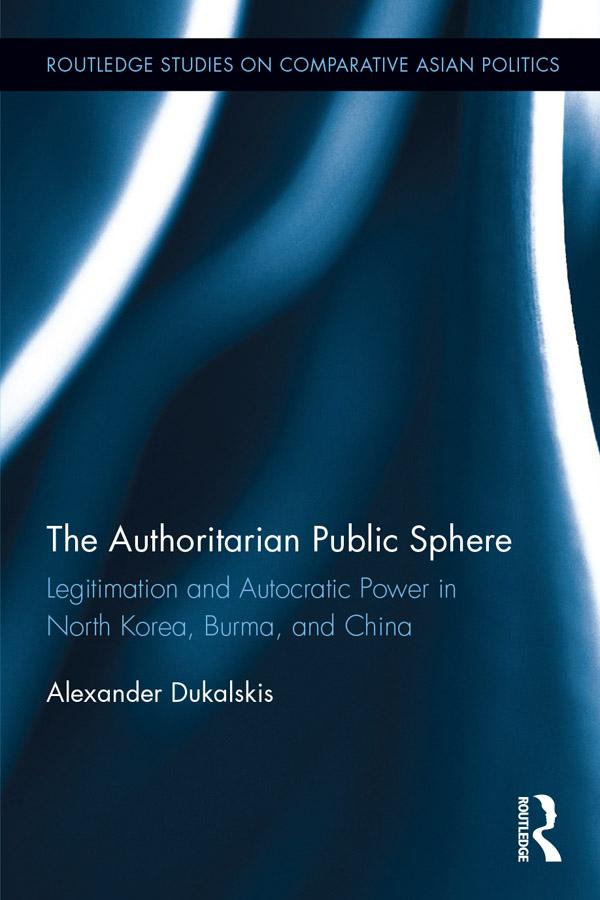
Authoritarian regimes craft and disseminate reasons, stories, and explanations for why they are entitled to rule. To shield those legitimating messages from criticism, authoritarian regimes also censor information that they find threatening. While committed opponents of the regime may be violently repressed, this book is about how the authoritarian state keeps the majority of its people quiescent by manipulating the ways in which they talk and think about political processes, the authorities, and political alternatives.
Using North Korea, Burma (Myanmar) and China as case studies, this book explains how the authoritarian public sphere shapes political discourse in each context. It also examines three domains of potential subversion of legitimating messages: the shadow markets of North Korea, networks of independent journalists in Burma, and the online sphere in China. In addition to making a theoretical contribution to the study of authoritarianism, the book draws upon unique empirical data from fieldwork conducted in the region, including interviews with North Korean defectors in South Korea, Burmese exiles in Thailand, and Burmese in Myanmar who stayed in the country during the military government. When analyzed alongside state-produced media, speeches, and legislation, the material provides a rich understanding of how autocratic legitimation influences everyday discussions about politics in the authoritarian public sphere.
Explaining how autocracies manipulate the ways in which their citizens talk and think about politics, this book will be of interest to students and scholars of Asian politics, comparative politics and authoritarian regimes.
Płać wygodnie kartą, Klarną, Apple Pay lub Google Pay. Nie jesteś zadowolony? Zawsze masz 14-dniową gwarancję zwrotu pieniędzy. Więcej przeczytasz w naszych warunkach. Masz pytania? Napisz do nas na hello@memmo.org.
Memmo ułatwia naukę – gdziekolwiek jesteś na świecie. U nas znajdziesz podręczniki i sprytne narzędzia do nauki w jednym miejscu: streszczenia, quizy, podcasty i fiszki. A do tego Ted, Twój kumpel do nauki, który odpowie na wszystko, co Cię nurtuje. Ponad 50 000 studentów już tu się uczy – stworzone, byś uczył się szybciej i mniej stresował.